PTZ PAN. TILT. ZOOM. The History of Robotic Cameras · By Jonathan Roberts
OPENING MONOGRAPH SPREAD (00 / 18) — USE ← / → ARROW KEYS TO FLIP PAGES
FIVE ERAS OF INTEGRATED ROBOTIC VISION (1960–2026)
Five Chromatic PTZ Cameras Stepping Through History
CLICK ANY OF THE 5 CAMERA TIERS ABOVE TO JUMP TO THAT ERA:
8.5" × 11.0" ILLUSTRATED MONOGRAPH
1960–2026 ARCHIVE
SOURCES S001–S045

PAN. TILT. ZOOM.

THE HISTORY OF ROBOTIC CAMERAS

BY JONATHAN ROBERTS

An eighteen-chapter illustrated coffee-table history and interactive primary-source vault tracing how cameras lost their optical viewfinders, shrank into ceiling domes and desktop robots, converged onto a single Ethernet cable, and gained neural eyes.

PART I (CH 1–2) · PRE-INTEGRATED ROOTS1957–1991 →
PART II (CH 3–7) · THE INTEGRATION BREAKTHROUGH1989–2002 →
PART III (CH 8–11) · THE NETWORKED & BROADCAST EYE1996–2022 →
PART IV (CH 12–14) · THE ONE-CABLE ECOSYSTEM2003–2026 →
PART V (CH 15–18) · THE AUTONOMOUS FRAME & HORIZONS2015–2035+ →
PART I · PRE-INTEGRATED ROOTS 1960–1988
PLATE 01.1 · 1960–1988 PART I · TITANIUM TIER 1971 RCA Ground-Commanded Television Assembly (GCTA · NAS 9-11260)
10 CURATED PLATES:
PLATE 1.1 · CHAPTER OPENER HERO SPREAD — TWO-PAGE FULL BLEEDNASA Johnson Space Center Archive (S007, S008) —

High-resolution NASA Apollo 15 surface photograph showing RCA’s Ground-Commanded Television Assembly (GCTA) wrapped in gold thermal blankets and glass mirror radiators on the front chassis of the Lunar Roving Vehicle at Hadley Rille (July 31, 1971), with the black lunar sky and Hadley Apennines behind it.

7.0 kg (15.5 lb)6:1 Angénieux Zoom80:1 Harmonic Drive1,024 Hz PSK (16-Bit)
01
CHAPTER 01 OF 18
VERIFIED CLAIMS: C001, C002

The Viewfinder-Less Studio and the Lunar Rover

BBC Alexandra Palace, Vinten Pedestals, and RCA’s Apollo Moon Camera

“For the first time in history, the person choosing the shot was not standing behind the lens—they were sitting 384,400 kilometers away in Houston.”

In October 1961, the BBC removed the floor cameraman from Studio B at Alexandra Palace, operating four EMI 201 cameras remotely. Ten years later, RCA Astro-Electronics and NASA’s Ed Fendell placed a 7-kilogram integrated color PTZ camera on the Apollo 15, 16, and 17 Lunar Roving Vehicles—commanding pans, tilts, and zooms across a three-second speed-of-light delay.

🎓 KEY AV & ROBOTICS CONCEPTS IN THIS CHAPTER (CLICK TO LEARN):
🏛️ PRIMARY ARCHIVAL SOURCES FOR THIS ERA (CLICK TO INSPECT IN VAULT):
PART I · PRE-INTEGRATED ROOTS 1957–1991
PLATE 02.1 · 1957–1991 PART I · TITANIUM TIER Pelco MPT9000 Coaxitron & American Dynamics AD2150 Matrix
10 CURATED PLATES:
PLATE 2.1 · CHAPTER OPENER HERO SPREAD — TWO-PAGE FULL BLEEDArchival industrial CCTV installation photograph

Dramatic architectural portrait of a classic 1970s/1980s outdoor industrial Pelco / Cohu CCTV station: a bulky environmental camera housing with sunshield, window wiper, and motorized zoom lens bolted atop a cast-aluminum AC pan-tilt scanner (140 VA), showing the thick multi-conductor junction box and conduit bundle strapped to the pole.

24V / 115V AC MotorsLine 18 VBI Pulses333 kHz PWM5,000-ft AD Manchester
02
CHAPTER 02 OF 18
VERIFIED CLAIMS: C017, C018

Heavy Iron, AC Motors, and the Coaxial Leash

Pelco’s Split-Phase Giants, Coaxitron Blanking Pulses, and Matrix Switchers

“Before a camera could become a nimble robot, engineers had to stop hauling eleven-wire bundles of high-voltage copper up every rooftop mast.”

Founded by aviation machinist E. L. Heinrich in 1957, Pelco and rivals like American Dynamics built the heavy die-cast AC pan-tilt heads that guarded airports and prisons. To break the multi-cable bottleneck, Pelco injected 15- and 32-bit PWM control bursts upstream inside Video Line 18 of the vertical blanking interval (Coaxitron), while Sensormatic patented the first ceiling retail domes.

🎓 KEY AV & ROBOTICS CONCEPTS IN THIS CHAPTER (CLICK TO LEARN):
🏛️ PRIMARY ARCHIVAL SOURCES FOR THIS ERA (CLICK TO INSPECT IN VAULT):
PART II · THE INTEGRATION BREAKTHROUGH 1989–1999
PLATE 03.1 · 1989–1999 PART II · MAGENTA TIER 1991 Sensormatic SpeedDome (US 5,223,872) & 1997 Pelco Spectra DD5
10 CURATED PLATES:
PLATE 3.1 · CHAPTER OPENER HERO SPREAD — TWO-PAGE FULL BLEEDSensormatic SpeedDome Ultra III Service Guide (8

Dramatic low-angle architectural photograph looking up at a 1990s casino and retail ceiling grid where a recessed Sensormatic SpeedDome Ultra / Pelco Spectra smoked hemisphere hangs above the floor, paired with an exposed studio macro shot of the 120mm ($4.75\text{-inch}$) gloss-black rotating eyeball assembly with its camouflaged slot cover removed to reveal the $12\times$ optical zoom lens.

4.5-Inch Eyeball360° Gold Slip Ring400°/sec Pan SlewZAP Speed Scaling
03
CHAPTER 03 OF 18
VERIFIED CLAIMS: C003, C006, C017, C018

The Eyeball in the Ceiling

Sensormatic’s SpeedDome, Pelco’s Spectra, and the Slip-Ring Revolution

“By shrinking the moving mass into a 4.5-inch spherical eyeball on cogged timing belts, the ceiling dome accelerated from 6 degrees per second to 400.”

In Boca Raton and Clovis, engineers Norbert Stiepel (Sensormatic SpeedDome) and Bob Herold (Pelco Spectra) replaced forty-pound yokes with plug-in spherical eyeballs, 12-circuit gold-on-gold slip rings for continuous 360° rotation, 0.25-second 180° nadir auto-flip, and Zoom Adjusted Programming (ZAP, US 5,801,770).

🎓 KEY AV & ROBOTICS CONCEPTS IN THIS CHAPTER (CLICK TO LEARN):
🏛️ PRIMARY ARCHIVAL SOURCES FOR THIS ERA (CLICK TO INSPECT IN VAULT):
PART II · THE INTEGRATION BREAKTHROUGH 1993–2008
PLATE 04.1 · 1993–2008 PART II · MAGENTA TIER Sony FCB-EX480C & Hitachi VK-S454 OEM Zoom Block Modules
10 CURATED PLATES:
PLATE 4.1 · CHAPTER OPENER HERO SPREAD — TWO-PAGE FULL BLEEDSony Image Sensing Solutions Archive (S019) / Au

Actual-size macro studio photograph of the Sony FCB-IX47A / FCB-EX480 color block camera ($48.2 \times 56.6 \times 92.3\text{ mm}$, $170\text{ grams}$) resting in an engineer’s palm next to a 9-pin Molex flat flexible ribbon cable (FFC), surrounded by the outer shells of five competing domes and PTZ cameras (Pelco Spectra, Sensormatic SpeedDome Ultra, Bosch/Philips AutoDome, Sony EVI-D100, and BirdDog P200) that all used FCB or VK-S optical blocks at their core.

1/4-Inch EXview CCD18× to 36× Optical Zoom230g (50×57×89mm)Zoom Trigger AF (5s)
04
CHAPTER 04 OF 18
VERIFIED CLAIMS: C009

The Engine Inside the Dome

Sony FCB & Hitachi VK-S Block Cameras, 1/4-Inch Optics, and the Autofocus Trap

“Inside competing American and European security domes beat the exact same Japanese optical heart—wired over a 30-pin micro-coax ribbon.”

Why could fifty different manufacturers suddenly build compact 20× and 36× zoom PTZ cameras in the late 1990s? Because Sony and Hitachi packaged the 1/4-inch CCD, 4-group internal zoom lens, auto-iris, and VISCA processor into a 230-gram rectangular OEM block—solving casino neon autofocus hunting with Zoom Trigger AF (8x 01 04 57 02 FF).

🎓 KEY AV & ROBOTICS CONCEPTS IN THIS CHAPTER (CLICK TO LEARN):
🏛️ PRIMARY ARCHIVAL SOURCES FOR THIS ERA (CLICK TO INSPECT IN VAULT):
PART II · THE INTEGRATION BREAKTHROUGH 1993–1998
PLATE 05.1 · 1993–1998 PART II · MAGENTA TIER 1994 Canon VC-C1 (FCC AZDVC-C1) & 1996 Sony EVI-D30 / EVI-G20
10 CURATED PLATES:
PLATE 5.1 · CHAPTER OPENER HERO SPREAD — TWO-PAGE FULL BLEEDU.S. Geological Survey Open-File Report 97-537 (

Archival USGS Hawaiian Volcano Observatory field photograph and schematic of the solar-powered HVO/RVTS-1 remote telemetry station at the Kilauea East Rift Zone (1997), paired with an inset portrait of the Canon VC-C1 MKII mounted inside its weatherproof field housing.

2.2 lb Desktop Body8× / 12× Optical ZoomAT-AE Color TrackingKīlauea Volcano Tested
05
CHAPTER 05 OF 18
VERIFIED CLAIMS: C004, C005, C019

The Boardroom Wants a Robot

Canon’s VC-C1, Sony’s EVI-D30, and the Birth of the Desktop PTZ

“Tested on the erupting Puʻu ʻŌʻō volcanic vent in 1997, a 2.2-pound desktop office robot outlasted industrial surveillance cameras.”

Moving out of the ceiling bubble onto conference tables and university lecterns, Canon’s 1994 VC-C1 and Sony’s 1996 EVI-D30 defined the exposed-head desktop PTZ camera—powering Canon’s 1996 WebView browser server, surviving Kīlauea’s sulfur plumes (USGS OFR 97-537), and introducing on-board AT-AE color-and-motion tracking.

🎓 KEY AV & ROBOTICS CONCEPTS IN THIS CHAPTER (CLICK TO LEARN):
🏛️ PRIMARY ARCHIVAL SOURCES FOR THIS ERA (CLICK TO INSPECT IN VAULT):
PART II · THE INTEGRATION BREAKTHROUGH 1991–2018
PLATE 06.1 · 1991–2018 PART II · MAGENTA TIER Sony VISCA (8x 01 06 01) vs. Pelco-D (0xFF Sync & Preset 95 OSD)
10 CURATED PLATES:
PLATE 6.1 · CHAPTER OPENER HERO SPREAD — TWO-PAGE FULL BLEEDSony CI-1000 Archive (S003) / Author Studio Phot

Split-era studio composition: on the left, Sony’s 1991 CI-1000 Vbox Video/Computer Interface (S003) connected via an 8-pin mini-DIN serial cable to an Apple Macintosh Classic and a Hi8 tape deck; on the right, a modern production desk where an Elgato Stream Deck running Bitfocus Companion fires the exact same hexadecimal VISCA byte sequence (81 01 06 01 ... FF) over an Ethernet switch to a PTZOptics Move 4K and a Sony BRC camera (S003, S029).

9600 Baud Serial7-Cam Mini-DIN Chain2-Socket ACK/DonePreset 95 OSD Hijack
06
CHAPTER 06 OF 18
VERIFIED CLAIMS: C004, C006, C025

The Babel of 9600 Baud

Sony VISCA, Pelco-D, Co-Opted Preset 95, and the Politics of Control

“To open a Pelco dome’s setup menu without adding a new button to 1980s keyboards, engineers hijacked Preset 95: FF 01 00 03 00 5F 63.”

For two decades, robotic cameras spoke two incompatible serial dialects: Sony’s stateful RS-232C VISCA protocol (with automatic daisy-chain addressing and two-buffer ACK/Completion handshakes) and Pelco’s 7-byte unidirectional RS-485 Pelco-D frame—later bridged by VISCA-over-IP, HTTP-CGI, and Bitfocus Companion.

🎓 KEY AV & ROBOTICS CONCEPTS IN THIS CHAPTER (CLICK TO LEARN):
🏛️ PRIMARY ARCHIVAL SOURCES FOR THIS ERA (CLICK TO INSPECT IN VAULT):
PART II · THE INTEGRATION BREAKTHROUGH 1992–1999
PLATE 07.1 · 1992–1999 PART II · MAGENTA TIER 1992 ParkerVision CameraMan (US 5,179,421) & 1996 PictureTel LimeLight
10 CURATED PLATES:
PLATE 7.1 · CHAPTER OPENER HERO SPREAD — TWO-PAGE FULL BLEEDParkerVision / PictureTel / European Patent EP 0

Three-panel archival and technical triptych illustrating the three 1990s automation philosophies side by side: (Left) A university distance-learning professor at a lectern wearing ParkerVision’s infrared/RF Tracking Ring while the integrated 3-CCD CameraMan System II tracks their movement (S011, S035); (Center) PictureTel’s $46 \times 30\text{ cm}$ LimeLight 4-microphone phased array sitting atop a PowerCam 100 PTZ camera on a Concorde 4500ZX cart (S012, S035); (Right) Figure 1 of Sensormatic’s EP 0714081A1 showing a ceiling $180^\circ$ fisheye "Pilot" dome (11) steering four SpeedDome "Slave" cameras (16, 18, 20, 22) across warehouse floor sectors (S004).

Rotary IR Beacon4-Cardioid Mic TDOA180° Fisheye PilotDelta-Frame Subtraction
07
CHAPTER 07 OF 18
VERIFIED CLAIMS: C007, C008

Rings, Microphones, and Delta Frames

ParkerVision’s CameraMan, PictureTel’s LimeLight, and Fisheye Pilot Domes

“Twenty-five years before deep-learning auto-trackers, 1990s engineers steered robotic cameras with spinning infrared drums, four-mic acoustic arrays, and fisheye pilot lenses.”

Long before neural networks, three ingenious 1990s systems automated the camera: ParkerVision’s CameraMan tracked a presenter’s infrared wristlet via a spinning slotted drum; PictureTel’s LimeLight triangulated human speech across four cardioid microphones; and Sensormatic’s Terry Glatt (EP 0714081A1) used a stationary 180° fisheye camera to aim high-speed SpeedDomes.

🎓 KEY AV & ROBOTICS CONCEPTS IN THIS CHAPTER (CLICK TO LEARN):
🏛️ PRIMARY ARCHIVAL SOURCES FOR THIS ERA (CLICK TO INSPECT IN VAULT):
PART III · THE NETWORKED & BROADCAST EYE 1996–2009
PLATE 08.1 · 1996–2009 PART III · AMBER TIER 2002 Canon VB-C10, Sony SNC-RZ30N & AXIS 2130 (645g Twin)
10 CURATED PLATES:
PLATE 8.1 · CHAPTER OPENER HERO SPREAD — TWO-PAGE FULL BLEEDCanon Inc. & Axis Communications AB Product Arch

Side-by-side forensic studio portrait of the three fraternal triplets of the 2000–2003 network transition: (Left) The June 2000 Canon VC-C4 analog RS-232C communication camera ($375\text{ g}$); (Center) The April 2002 Canon VB-C10 network PTZ camera ($645\text{ g}$, $106.0 \times 143.1 \times 111.0\text{ mm}$); and (Right) The October 2002 / January 2003 Axis 2130 PTZ Network Camera ($645\text{ g}$, $106.0 \times 143.1 \times 111.0\text{ mm}$)—visually proving how Canon’s $16\times$ optical zoom head and pan-tilt mechanism were grafted directly onto a 10/100BASE-TX Ethernet web-server pedestal (S010, S013, S022).

Embedded HTTP Server645g Shared ChassisETRAX 100LX uClinuxIEEE 802.3at PoE+ (25.5W)
08
CHAPTER 08 OF 18
VERIFIED CLAIMS: C011, C020

A Web Server with a Neck

Canon’s VB-C10, Sony’s SNC-RZ30N, Axis’s 2130, and the PoE+ Bottleneck

“Primary specification sheets prove a remarkable historical kinship: the 2002 Canon VB-C10 and the AXIS 2130 shared the exact same 645-gram body and 16× lens.”

In 2002, Canon (VB-C10, April 25), Sony (SNC-RZ30N, August 21), and Axis (AXIS 2130, October 2002 / January 2003) embedded HTTP web servers directly inside the PTZ base. Yet early 12.95W PoE (802.3af) browned out whenever three stepper motors accelerated at once—until IEEE 802.3at PoE+ delivered 25.5W in September 2009.

🎓 KEY AV & ROBOTICS CONCEPTS IN THIS CHAPTER (CLICK TO LEARN):
🏛️ PRIMARY ARCHIVAL SOURCES FOR THIS ERA (CLICK TO INSPECT IN VAULT):
PART III · THE NETWORKED & BROADCAST EYE 2008–2020
PLATE 09.1 · 2008–2020 PART III · AMBER TIER ONVIF PTZ Service Specification (GenericPanTiltPositionSpace)
10 CURATED PLATES:
PLATE 9.1 · CHAPTER OPENER HERO SPREAD — TWO-PAGE FULL BLEEDONVIF Public Specification Archive (onvif_core_v

Archival-style technical composition of the October 7–10, 2008 Security 2008 exhibition in Essen, Germany (Booth GA-134) and the December 3–4, 2008 Washington, D.C. first member meeting (93 participants from 60+ companies), overlaid with the title page of the November 2008 ONVIF Core Specification Version 1.0 listing the 16 founding engineers from Axis Communications (Lund), Bosch Security Systems (Grasbrunn), and Sony Corporation (Tokyo) (S016).

[-1.0, +1.0] Pan/Tilt[0.0, 1.0] Zoom SpaceWS-Discovery Multicast12-KB SOAP XML Envelope
09
CHAPTER 09 OF 18
VERIFIED CLAIMS: C013

Truce in Essen: ONVIF vs. PSIA

How Normalized [-1.0, +1.0] Coordinate Spaces Ended the IP Protocol Wars

“Before ONVIF, security software companies paid $20,000 per camera model just to write custom pan-tilt drivers.”

In May 2008, Axis, Bosch, and Sony formed ONVIF to battle the rival PSIA alliance (Cisco, Pelco, Panasonic). Despite its heavy 12-kilobyte SOAP/XML headers, ONVIF won by mandating plug-and-play WS-Discovery and mapping every manufacturer’s physical angle limits onto a universal [-1.0, +1.0] floating-point coordinate space.

🎓 KEY AV & ROBOTICS CONCEPTS IN THIS CHAPTER (CLICK TO LEARN):
🏛️ PRIMARY ARCHIVAL SOURCES FOR THIS ERA (CLICK TO INSPECT IN VAULT):
PART III · THE NETWORKED & BROADCAST EYE 1999–2012
PLATE 10.1 · 1999–2012 PART III · AMBER TIER 2004 Sony BRC-300, 2008 Panasonic AW-HE100 & Camera Corps Q-Ball
10 CURATED PLATES:
PLATE 10.1 · CHAPTER OPENER HERO SPREAD — TWO-PAGE FULL BLEEDChannel 4 / The Garden / Dragonfly / Panasonic C

Dramatic behind-the-scenes production spread of a British "fixed-rig" documentary gallery (24 Hours in A&E / One Born Every Minute, c. 2011): a wall of 92 live hospital monitor feeds inside a portable production cabin (Portakabin) where a single robotic camera operator and gallery director steer ceiling-mounted PTZ cameras (Panasonic AW-HE60/HE120 and Camera Corps Q-Ball), paired with an inset view of an unobtrusive white PTZ camera mounted above a hospital resuscitation bay (S015, S024, S038).

3× 1/3-Inch IT-CCDsDichroic RGB PrismNC30 Fanless Quiet±3 Arc-Min Repeatability
10
CHAPTER 10 OF 18
VERIFIED CLAIMS: C010, C021

Good Enough for Air

Big Brother, 92-Camera Fixed-Rig Documentaries, and the 3-CCD Broadcast PTZ

“Wiring 92 remotely controlled PTZ cameras into King’s College Hospital on 24 Hours in A&E unlocked a human vulnerability handheld crews could never capture.”

Reality television (Big Brother’s ‘Metal Mickey’ and 115mm Q-Ball) and British fixed-rig documentaries (The Family, One Born Every Minute, 24 Hours in A&E) pushed robotic cameras onto prime-time air—driving Sony (BRC-300/H700) and Panasonic (AW-HE100) to build 3-CCD prism-block PTZs with NC30 acoustic isolation and ±0.05° stopping accuracy.

🎓 KEY AV & ROBOTICS CONCEPTS IN THIS CHAPTER (CLICK TO LEARN):
🏛️ PRIMARY ARCHIVAL SOURCES FOR THIS ERA (CLICK TO INSPECT IN VAULT):
PART III · THE NETWORKED & BROADCAST EYE 2008–2022
PLATE 11.1 · 2008–2022 PART III · AMBER TIER 2020 Panasonic AW-UE100 Gearless Direct Drive & Sony BRC-X1000
10 CURATED PLATES:
PLATE 11.1 · CHAPTER OPENER HERO SPREAD — TWO-PAGE FULL BLEEDPanasonic Broadcast & Professional AV Technology

Split macro and concert-hall spread: on the left, a Panasonic AW-UE100 / AW-UE160 mounted on a symphony hall balcony rail framing a solo cellist 120 feet away at $24\times$ optical zoom; on the right, Panasonic’s official engineering cutaway of the Direct Drive (D.D.) gearless motor ring and optical rotary encoder inside the camera’s pan-tilt axis (S015, S039).

0.000° Gear BacklashNC25 Acoustic Floor0.08°/s to 300°/sHybrid OIS + Roll EIS
11
CHAPTER 11 OF 18
VERIFIED CLAIMS: C012

The Telephoto Trap

Gear Backlash, VTR Direct Drive, PTZ Motion Sync, and OIS+EIS Stabilization

“At 24× telephoto zoom on a 4K sensor, a tenth of a degree of worm-gear backlash jumps 116 pixels across the television screen.”

A PTZ camera that looks smooth while stationary can ruin a live broadcast the instant it moves at tight telephoto zoom. Engineers solved the ‘Telephoto Trap’ by adapting gearless broadcast VTR direct-drive motors (Panasonic AW-UE100, NC25), coordinated 3-axis S-curve trajectory sync (PTZ Motion Sync), Class 100 clean-room lens alignment, and hybrid OIS+EIS.

🎓 KEY AV & ROBOTICS CONCEPTS IN THIS CHAPTER (CLICK TO LEARN):
🏛️ PRIMARY ARCHIVAL SOURCES FOR THIS ERA (CLICK TO INSPECT IN VAULT):
PART IV · THE ONE-CABLE ECOSYSTEM 2003–2018
PLATE 12.1 · 2003–2018 PART IV · LIME TIER 2003 Logitech QuickCam Orbit, Polycom EagleEye Director & Cisco SpeakerTrack 60
10 CURATED PLATES:
PLATE 12.1 · CHAPTER OPENER HERO SPREAD — TWO-PAGE FULL BLEEDLogitech Archive (S027), Cisco SpeakerTrack 60 G

Split visual contrast of the two ends of the conferencing spectrum: on the left, Logitech’s October 2003 QuickCam Orbit / Sphere ($129.95, S027) perched atop its 9-inch eye-level stalk with its glowing red LED and mechanical pan-tilt eyeball; on the right, Cisco’s dual-camera TelePresence SpeakerTrack 60 (S027) and Polycom’s EagleEye Director (S020), where two synchronized HD PTZ cameras sit side by side above a four-microphone array to hide mechanical camera moves from remote viewers.

Dual-Cam Off-Air SlewUSB UVC 0x0B–0x0E1 Arc-Second UnitsZero Custom Drivers
12
CHAPTER 12 OF 18
VERIFIED CLAIMS: C014, C022, C025

Hiding the Move

Dual-Camera Telepresence, USB Video Class (UVC), and the Cloud Conferencing Shift

“The cleverest way to make a robotic camera move look broadcast-professional in a boardroom was to never let the audience see the camera move at all.”

To stop conference-room panning from making remote viewers seasick, Polycom (EagleEye Director) and Cisco/TANDBERG (SpeakerTrack 60) paired two PTZ cameras—slewing the off-air camera at 150°/s while the on-air camera held still, then executing a clean cut. Meanwhile, USB Video Class (UVC 0x0B–0x0E) and Zoom sparked the plug-and-play USB PTZ boom.

🎓 KEY AV & ROBOTICS CONCEPTS IN THIS CHAPTER (CLICK TO LEARN):
🏛️ PRIMARY ARCHIVAL SOURCES FOR THIS ERA (CLICK TO INSPECT IN VAULT):
PART IV · THE ONE-CABLE ECOSYSTEM 2015–2022
PLATE 13.1 · 2015–2022 PART IV · LIME TIER PTZOptics NDI|HX, BirdDog Full-NDI Silicon (P200) & Bitfocus Companion
10 CURATED PLATES:
PLATE 13.1 · CHAPTER OPENER HERO SPREAD — TWO-PAGE FULL BLEEDPanasonic (S015), PTZOptics (S020, S029), & Bird

Split architectural and hardware spread: on the left, a single glowing blue Cat6 Ethernet cable (PoE+ / NDI) plugging into the rear of a PTZ camera, replacing a tangled five-cable bundle of 3G-SDI coax, HDMI, RS-422 control, Tally, and 12V DC power; on the right, the triad of cameras that pioneered the 2015–2018 IP production wave: the PTZOptics 20X-SDI / NDI (2015/2017), the Panasonic AW-HN130 / UN70 (2017), and the BirdDog Eyes P200 (2018) (S015, S020, S028, S029).

5 Lifelines on 1 Cat6Full NDI (~140 Mbps)NDI|HX3 (~20 Mbps)Stream Deck VISCA-IP
13
CHAPTER 13 OF 18
VERIFIED CLAIMS: C024, C025

One Cable to Rule the Studio

NewTek NDI, PoE+, Open Control APIs, and the Rise of the Challenger Brands

“One standard Cat6 Ethernet cable suddenly carried phantom power, 4K video, audio, tally lights, and bidirectional pan-tilt-zoom control.”

In September 2015, NewTek’s Dr. Andrew Cross launched NDI, turning local area networks into video routers. Combined with PoE+, open HTTP-CGI / VISCA-over-IP APIs, Bitfocus Companion Stream Decks, and challenger brands like PTZOptics (Downingtown, PA) and BirdDog (Melbourne), single-cable IP workflows democratized multi-camera production worldwide.

🎓 KEY AV & ROBOTICS CONCEPTS IN THIS CHAPTER (CLICK TO LEARN):
🏛️ PRIMARY ARCHIVAL SOURCES FOR THIS ERA (CLICK TO INSPECT IN VAULT):
PART IV · THE ONE-CABLE ECOSYSTEM 2018–2026
PLATE 14.1 · 2018–2026 PART IV · LIME TIER 2022 Sony ILME-FR7 (35mm Full-Frame E-Mount) & Panasonic AW-UE150/160
10 CURATED PLATES:
PLATE 14.1 · CHAPTER OPENER HERO SPREAD — TWO-PAGE FULL BLEEDSony Electronics Cinema Line Archive (S017, S042

Dramatic studio portrait of the Sony ILME-FR7 Cinema Line Full-Frame PTZ Camera (September 2022, S017, S042) mounted with the FE PZ 28-135mm F4 G OSS (SELP28135G) power-zoom cinema lens on 15mm support rods inside an LED-volume / green-screen virtual production stage, with a real-time 3D Unreal Engine environment rendered behind the subject in perfect perspective sync via FreeD.

35.6×23.8mm (847 mm²)ISO 800 / 12,800 Base1/4–1/128 Variable ND29-Byte 0xD1 FreeD
14
CHAPTER 14 OF 18
VERIFIED CLAIMS: C016, C023

Breaking the Small-Sensor Ceiling

1.0-Inch Broadcast Flagships, Sony’s Full-Frame ILME-FR7, and 29-Byte FreeD Virtual Sets

“Spanning 87 times the silicon area of a 1/4-inch dome sensor, Sony’s ILME-FR7 brought shallow 35mm cinema bokeh and interchangeable glass to a robotic neck.”

After stepping up to 1.0-inch sensors (Sony BRC-X1000, Panasonic AW-UE150/160), Sony unveiled the full-frame E-mount ILME-FR7 on September 6, 2022—requiring 15mm support rods, slide-base balancing, electronic variable ND filters, and 71.3W PoE++. Simultaneously, PTZ encoders revived the BBC’s 1997 29-byte 0xD1 FreeD packet to drive Unreal Engine virtual studios.

🎓 KEY AV & ROBOTICS CONCEPTS IN THIS CHAPTER (CLICK TO LEARN):
🏛️ PRIMARY ARCHIVAL SOURCES FOR THIS ERA (CLICK TO INSPECT IN VAULT):
PART V · THE AUTONOMOUS FRAME & FUTURE HORIZONS 2015–2026
PLATE 15.1 · 2015–2026 PART V · CYAN TIER 2019 OBSBOT Tail (Hi3559A 5-TFLOPS) & 2025 OBSBOT Tail 2 (3-Axis PTZR)
10 CURATED PLATES:
PLATE 15.1 · CHAPTER OPENER HERO SPREAD — TWO-PAGE FULL BLEEDRemo Tech / OBSBOT Archive (S020, S043) — Permis

Dynamic split-horizon studio and street-dance photograph comparing the 2019 OBSBOT Tail (610g 3-axis AI autonomous director camera tracking a breakdancer on a rooftop) with the March 2025 OBSBOT Tail 2 PTZR 4K Live Production Camera (OAB-2305-CW, S043) mid-rotation as its third motorized Roll (R) axis pivots the 12-element lens barrel $90^\circ$ from horizontal 16:9 broadcast framing into native 9:16 vertical $4\text{K}/60\text{p}$ framing.

τ_c = 0 On-Chip NPU1/1.5" 50MP CMOS90° PTZR Vertical Roll±0.003° 6-Axis IMU
15
CHAPTER 15 OF 18
VERIFIED CLAIMS: C015, C026

From Camshift to Neural Gimbals

Closed-Loop Latency (τ = τ_m + τ_p + τ_c) and the 3-Axis PTZR Personal Robot

“In an active PTZ camera, every tracking decision physically moves the lens—changing the exact pixels the neural network will see in the very next frame.”

In May 2015, Chen et al. (arXiv:1505.04502) proved why classical color-histogram trackers (Camshift) failed under closed-loop delay τ = τ_m + τ_p + τ_c. Four years later, Remo Tech’s OBSBOT Tail embedded a 5-TFLOPS neural chip inside a 3-axis brushless gimbal—evolving into the March 2025 OBSBOT Tail 2 PTZR, whose third motorized Roll axis rotates 90° for lossless 4K60 vertical video.

🎓 KEY AV & ROBOTICS CONCEPTS IN THIS CHAPTER (CLICK TO LEARN):
🏛️ PRIMARY ARCHIVAL SOURCES FOR THIS ERA (CLICK TO INSPECT IN VAULT):
PART V · THE AUTONOMOUS FRAME & FUTURE HORIZONS 2020–2026
PLATE 16.1 · 2020–2026 PART V · CYAN TIER Sony BRC-AM7, Canon RA-AT001, ETH Zurich Seervision & UCLA Eagle RL
10 CURATED PLATES:
PLATE 16.1 · CHAPTER OPENER HERO SPREAD — TWO-PAGE FULL BLEEDSony Corporation Professional Archive (S044) — P

Studio and live-event portrait of the Sony BRC-AM7 $1.0\text{-Type}$ 4K 60p AI Auto-Framing Broadcast PTZ Camera (April 2024, S044) operating in a concert/lecture auditorium, with its dual front tally lamps illuminated (Red at left for On-Air Program, Green at right confirming active PTZ Auto Framing), overlaid with a subtle translucent HUD visualization of its four-layer neural lock (18-point Skeleton, Head box, Face ID, and Clothing Texture mesh) and Lead Room Effect vector.

4-Layer Skeletal AI8 Stage GuardrailsModel Predictive MPCEagle RL (90× Smaller)
16
CHAPTER 16 OF 18
VERIFIED CLAIMS: C015, C027

The Seven Rungs of Camera Autonomy

What Ships Today vs. What Demos Well: Guardrails, MPC, and Deep Reinforcement Learning

“At Caledonian Stadium in October 2020, an automated ball-tracking AI camera spent the afternoon zooming in on the assistant referee’s sun-lit bald head.”

Separating trade-show hype from live-production reality requires climbing Seven Rungs of Autonomy—from presets, voice lobes, and IR tags to 4-layer on-camera auto-framing (Sony BRC-AM7), the 8 spatial guardrails (Halting Deadbands and Poster Exclusion Masks in Canon RA-AT001 and PTZOptics Move 4K), ETH Zurich/Q-SYS Seervision’s Model Predictive Control, and UCLA’s end-to-end Deep-RL Eagle policy.

🎓 KEY AV & ROBOTICS CONCEPTS IN THIS CHAPTER (CLICK TO LEARN):
🏛️ PRIMARY ARCHIVAL SOURCES FOR THIS ERA (CLICK TO INSPECT IN VAULT):
PART V · THE AUTONOMOUS FRAME & FUTURE HORIZONS 2025–2035+
PLATE 17.1 · 2025–2035+ PART V · CYAN TIER 2025 Canon 410MP LI8030SA (24K), Dallmeier Panomera & Oxford Wearable Robot
10 CURATED PLATES:
PLATE 17.1 · CHAPTER OPENER HERO SPREAD — TWO-PAGE FULL BLEEDCanon Inc. Industrial Sensors Archive & Universi

Split-horizon conceptual and hardware showcase contrasting the two extremes of the moving camera’s future (S045): (Left) Canon’s LI8030SA 410-Megapixel ($24,592 \times 16,704$, 24K) Full-Frame Stacked CMOS Wafer gleaming under clean-room inspection light, overlaid with a grid showing 49 simultaneous independent 4K ($3840 \times 2160$) digital PTZ crop windows extracted from a single frame; (Right) A field engineer and creator wearing an articulated 3-axis micro-gimbal Wearable Visual Robot on the shoulder collar—inspired by the University of Oxford Active Vision Lab prototype and DJI Osmo Pocket 3 micro-gimbal (S045)—stabilizing its gaze on the wearer’s hands while the body moves.

24,592×16,704 (410MP)49× 4K Crops @ 0msd_Airy = 2.44 λ N3-Axis Shoulder SLAM
17
CHAPTER 17 OF 18
VERIFIED CLAIMS: C028

Three Horizons

410-Megapixel Solid-State Digital PTZs, Hybrid Framing, and Wearable Visual Robots

“A single 410-megapixel full-frame wafer contains forty-nine independent 4K frames—yet wave diffraction and photon shot noise guarantee that moving glass will not die.”

Canon’s January 2025 410-megapixel full-frame CMOS sensor (LI8030SA) and Dallmeier’s 8-lens Panomera array allow dozens of zero-inertia virtual PTZ crops from a stationary camera. Yet Airy disk diffraction (d_Airy = 2.44 λ N) and 3,900-electron well depth point toward a Hybrid Mechanical-Digital synthesis—alongside shoulder-mounted Wearable Visual Robots (pioneered at Oxford in 2002) with socially legible privacy eyelids.

🎓 KEY AV & ROBOTICS CONCEPTS IN THIS CHAPTER (CLICK TO LEARN):
🏛️ PRIMARY ARCHIVAL SOURCES FOR THIS ERA (CLICK TO INSPECT IN VAULT):
PART V · THE AUTONOMOUS FRAME & FUTURE HORIZONS 1960–2026
PLATE 18.1 · 1960–2026 PART V · CYAN TIER Apollo 17 Taurus-Littrow (Dec 14, 1972) & 24 Hours in A&E Gallery
10 CURATED PLATES:
PLATE 18.1 · CHAPTER OPENER HERO SPREAD — TWO-PAGE FULL BLEEDNASA / Smithsonian National Air and Space Museum

Iconic split archival and modern diptych bringing the book’s 65-year journey full circle: (Left) The final television frame transmitted by the RCA Ground-Commanded Television Assembly (GCTA) on the Lunar Roving Vehicle at Taurus-Littrow on December 14, 1972 (S007, S008, S030), looking across the empty, sunlit tracks in the lunar dust after Ed Fendell tilted the camera down following the liftoff of Apollo 17’s Challenger; (Right) A modern remote broadcast gallery where a human camera operator’s hand rests lightly—unmoving—on the pan-tilt joystick and zoom rocker of an IP controller (Sony RM-IP500 / Panasonic AW-RP150) while watching a quiet, emotionally charged two-shot on a 4K monitor wall.

T - 2.3s Liftoff Lead92-Cam Trauma RigRed / Green Tally Ethic0.00°/sec Restraint
18
CHAPTER 18 OF 18
VERIFIED CLAIMS: C002, C021, C027, C028

When to Stay Still

Apollo 17’s Final Tilt-Down, Fixed-Rig Empathy, and Human Taste vs. the Machine Eye

“An algorithm optimizes for the person who is speaking; a human storyteller pans away to hold a quiet close-up on the clasped hands of the person who is listening.”

On December 14, 1972, after tracking Apollo 17’s ascent stage into the lunar sky, Ed Fendell tilted the RCA robot back down to the footprints in the dust and left the camera completely still. From the Moon to 92-camera hospital documentaries and 2026 AI co-pilots, the ultimate art of the moving camera remains knowing when not to move.

🎓 KEY AV & ROBOTICS CONCEPTS IN THIS CHAPTER (CLICK TO LEARN):
🏛️ PRIMARY ARCHIVAL SOURCES FOR THIS ERA (CLICK TO INSPECT IN VAULT):
LIVING ARCHIVE & BIBLIOGRAPHY

Primary Source & Patent Vault (S001–S045)

S001 Corporate Archive 1996

Sony News Release 96B-040 & PC Watch (EVI-D30 & EVI-G20)

Documents March 18, 1996 announcement of the EVI-D30 (12× zoom, AT-AE tracking) and 450g EVI-G20 ('Mach Speed Direct Drive' 150°/s).

Used in: Ch. 5, 6 Inspect Primary Source ↗
S002 Technical Manual 1996

Sony EVI-D30/D31 Communication Color Video Camera Brochure

Full optical/mechanical specs, AT-AE color/luminance algorithm, and IR vs. RS-232C VISCA control matrix.

Used in: Ch. 5, 6 Inspect Primary Source ↗
S003 Protocol Spec 1991

Sony CI-1000 Vbox Operating Instructions (Part 3-753-238-22)

Foundational 1991 specification of Sony's 9600-baud VISCA daisy-chain protocol (8x ... FF).

S004 Patent 1994

Sensormatic EP 0714081A1 / US 6,724,421 (Terry L. Glatt)

Discloses stationary 180° fisheye pilot camera using delta-frame motion vectors to steer high-speed SpeedDome slave cameras.

S005 SEC 10-K & Manual 1994

Sensormatic FY1994 Form 10-K & SpeedDome Ultra III/IV Service Guides

Verifies 63,000 installed domes ($73M revenue by 1994), slip-ring maintenance, and line-lock synchronization.

S006 Protocol & Manual 1997

Pelco SD5 Spectra Manual (C1456M) & Pelco-D Protocol Manual (TF-0002)

Documents the 3-piece Spectra pendant dome and the 7-byte Pelco-D RS-485 frame including co-opted Preset 95 OSD menu.

Used in: Ch. 3, 6 Inspect Primary Source ↗
S007 NASA Manual 1971

RCA Ground-Commanded Television Assembly (GCTA) Manual (NAS 9-11260)

Primary engineering manual for the 7.0-kg Apollo 15–17 Lunar Rover PTZ camera (80:1 Harmonic Drive, 6:1 zoom, 1,024 Hz PSK).

Used in: Prologue, Ch. 1, 18 Inspect Primary Source ↗
S008 NASA Archive 1971–1972

Apollo Lunar Surface Journal: Shooting the Apollo Moonwalks (Sam Russell & Ed Fendell)

Documents Ed Fendell's remote operation from Houston Bldg 30 and the T - 2.3s pre-ignition tilt on Apollo 17.

Used in: Prologue, Ch. 1, 18 Inspect Primary Source ↗
S009 Broadcast Paper 1961–1973

BBC Alexandra Palace Unmanned Studio B (EMI 201) & IEE Electronics and Power

Documents the October 1961 viewfinder-less BBC News studio and Evershed Power Optics analog servo pots.

S010 FCC & Manuals 1993–2000

Canon FCC Grant AZDVC-C1 (VC-C1, Nov 1993) & VC-C3 / VC-C4 Manuals

Proves Canon's Jan 5, 1994 FCC grant for the desktop VC-C1, detachable CCU-V1 on VC-C3, and SW3 backward-compatibility mode.

Used in: Ch. 5, 8 Inspect Primary Source ↗
S011 SEC 10-K 1992–1996

ParkerVision FY1996 Form 10-K (CameraMan I & System II)

Details the 1992 CameraMan rotary infrared tracking system and 1995/1996 integrated 1-CCD/3-CCD robotic cameras.

S012 IEEE & SEC 10-K 1996–1997

PictureTel FY1997 Form 10-K & 1997 IEEE WASPAA Voice Localization

Documents PictureTel's LimeLight 4-microphone acoustic camera pointer and PowerCam 100 videoconferencing PTZ.

S013 User Manual 2002–2003

Axis Communications AXIS 2130/2130R PTZ Network Camera Manual (Oct 2002)

Details the ETRAX 100LX embedded web server, 16× Canon zoom block, and external PTZ Connection Box.

S014 Broadcast Guide 2004–2006

Sony BRC Series System Guide (BRC-300, BRC-H700, BRC-Z700)

Documents the March 2004 BRC-300 (3-CCD SD) and March 2006 BRC-H700 (3-CCD HD) broadcast PTZ cameras.

Used in: Ch. 10 Inspect Primary Source ↗
S015 Whitepaper 1999–2022

Panasonic PTZ Camera Systems Technological Itinerary & 10-Year Whitepaper

Traces Panasonic's lineage from 1999 AW-E600 to 2008 AW-HE100, 2018 AW-UE150 (1-inch 4K60, FreeD), and 2022 AW-UE160.

Used in: Ch. 10, 11, 14 Inspect Primary Source ↗
S016 Standard Spec 2008–2020

ONVIF Core Specification v1.0 (Nov 2008) & PTZ Service Specification

Defines PTZNode, GenericPanTiltPositionSpace [-1.0, +1.0], GenericZoomPositionSpace [0.0, 1.0], and SOAP/XML control.

S017 Launch Archive 2022

Sony Electronics ILME-FR7 Launch Release (Sept 6, 2022)

Announces the full-frame (35.6×23.8mm) E-mount interchangeable-lens Cinema Line PTZ camera with exact footnote qualifier.

Used in: Ch. 14 Inspect Primary Source ↗
S018 arXiv / ACM Papers 2015 & 2023

Chen et al. (arXiv:1505.04502) & Sandha et al. UCLA Eagle (arXiv:2304.04356)

Establishes the closed-loop delay equation τ = τ_m + τ_p + τ_c (2015) and end-to-end Deep Reinforcement Learning PTZ control (2023).

Used in: Ch. 15, 16 Inspect Primary Source ↗
S019 Datasheet Archive 1998–2014

Sony FCB-IX / FCB-EX Series OEM Color Camera Module Datasheets

Documents the 1/4-inch CCD 18×–36× zoom block modules that standardized the global dome camera industry.

S020 Trade Records 2009–2019

Vaddio ClearVIEW/Hot-Shot, Polycom EagleEye Director, PTZOptics (2015) & OBSBOT (2019)

Primary launch records across Pro-AV, dual-camera telepresence, triple-stream NDI/USB PTZs, and edge-AI gimbals.

Used in: Ch. 12, 13, 15 Inspect Primary Source ↗
S021 Patent Lineage 1976–1998

Sensormatic Dome Patents: US 3,935,380, US 4,833,534, US 4,984,089, US 5,223,872 & US 5,801,770

Complete patent chain from 1976 retail dome to 1989 12-inch SensorVision, 1991 SpeedDome eyeball, and 1994 ZAP speed scaling.

Used in: Ch. 2, 3 Inspect Primary Source ↗
S022 Specs & CVIU Paper 2002–2006

Canon VB-C10 (Apr 25, 2002), Sony SNC-RZ30N (Aug 21, 2002) & Sinha/Pollefeys Calibration

Proves Canon and Sony shipped integrated network PTZs in spring/summer 2002 and documents open-loop stepper calibration.

S023 Engineering History 1957–2007

Pelco Corporate & Engineering History (Heinrich, McDonald, Arbuckle, Herold)

Documents Pelco's 1957 founding, 1987 acquisition by David McDonald, and Bob Herold's team developing the 1997 Spectra dome.

Used in: Ch. 2, 3 Inspect Primary Source ↗
S024 Broadcast Records 2000–2011

Forward Vision MIC1-300 ('Metal Mickey') & Camera Corps 115mm Q-Ball

Documents the ruggedized resolver-driven PTZ domes and aluminum spheres built for Big Brother UK and Africa.

Used in: Ch. 10 Inspect Primary Source ↗
S025 Patent & Manual 1997–2025

BBC R&D G. A. Thomas (IBC 1997, EP 1015909) & Vinten Radamec free-d Manual (v1.4.4)

Details the 1997 upward-facing ceiling-barcode camera and the 29-byte 0xD1 RS-422 packet structure.

Used in: Ch. 14 Inspect Primary Source ↗
S026 USGS & W3C Reports 1996–1997

W3C Paper 26 (Canon WebView, Oct 1996), Seattle Univ. & USGS Open-File Report 97-537 (Kīlauea)

Documents the solar-powered Canon VC-C1 MkII surviving the 1997 Puʻu ʻŌʻō volcanic vent eruption.

S027 Manual & Press 2003 & 2016

Logitech QuickCam Orbit (Oct 28, 2003) & Cisco SpeakerTrack 60 Guide (78-100223-02E0)

Details consumer USB mechanical face-tracking webcams and enterprise dual-camera off-air switching.

Used in: Ch. 12 Inspect Primary Source ↗
S028 Hardware Profile 2016–2023

BirdDog Custom NDI Silicon Timeline (Dan Miall & Eamon Drew, Melbourne)

Documents the September 2018 IBC debut of the BirdDog Eyes P100/P200 Full-NDI (~140 Mbps I-frame) PTZ cameras.

Used in: Ch. 13 Inspect Primary Source ↗
S029 Developer & Trade 2013–2025

Haverford Systems / PTZOptics History, NDI|HX (July 2017) & VISCA-over-IP / Companion APIs

Documents the integrator-led launch of HuddleCamHD and PTZOptics, open HTTP-CGI/VISCA-IP control, and Move 4K / Hive.

Used in: Ch. 6, 12, 13, 16 Inspect Primary Source ↗
S030 Archival Journals 1960–2008

EMI 201 Datasheet (BBC Monograph 39), Vinten History (GTC) & Clive North ZERB Apollo Interview

Primary reminiscences of BBC Alexandra Palace (1961), Vinten Peregrine/Microswift, and Ed Fendell's Apollo 17 liftoff.

Used in: Ch. 1, 18 Inspect Primary Source ↗
S031 Timing Specs 1974–2002

Pelco Coaxitron Timing Spec (coaxspec121602revC.pdf) & American Dynamics MegaPower 168

Exact electrical timing of 15/32-pulse Line-18 Coaxitron PWM bursts and 5,000-ft AD Manchester twisted-pair telemetry.

S032 Operator Manuals 1995–2004

Sensormatic View Manager 32 (VM32) & ADTT16E TouchTracker Operator's Manuals

Documents the 3-revolution Apple Peel pattern (30° tilt step), 180° proportional dome flip, and ZAP speed scaling.

S033 Block Manuals 1998–2016

Sony FCB-EX480C/CP Manual, Hitachi VK-S454 Service Manual & Pelco Spectra IV Horizon

Documents VISCA autofocus modes (Normal, Interval, 5-second Zoom Trigger AF) and 60° dome bubble refraction.

S034 Byte Manuals 1991–2018

Sony EVI-D100/H100S VISCA Command Guide & Pelco-D Preset 95 Support Bulletins

Byte-by-byte breakdown of VISCA 2-socket ACK/Completion handshakes and Pelco-D reserved presets (33, 34, 86–89, 95, 99).

S035 Patents & ICASSP 1990–1997

ParkerVision US Patents 5,179,421 / 5,471,296 & Wang/Chu 1997 IEEE ICASSP (LimeLight)

Mathematical and mechanical disclosures of rotary IR blinder tracking and 4-mic zero-lag voice triangulation.

S036 IEEE Standards 2003–2018

IEEE 802.3af (PoE 12.95W), 802.3at (PoE+ 25.5W, Sept 2009) & 802.3bt (PoE++ 71.3W)

Power budget tables and Layer 2 LLDP dynamic power negotiation for motorized network PTZ cameras.

Used in: Ch. 8, 13, 14 Inspect Primary Source ↗
S037 Standards Analysis 2008–2016

IPVM ONVIF vs. PSIA Reports, eInfochips SOAP/REST Analysis & ONVIF PTZ v2.60 Spec

Documents why ONVIF's mandatory WS-Discovery and normalized coordinate spaces defeated PSIA.

S038 RTS & ADAPT 2008–2015

Royal Television Society & ADAPT TV History: Fixed-Rig Documentary (24 Hours in A&E) & AW-HE100

Documents 92-camera hospital rigs, dual 'Blue'/'Red' remote galleries, and Panasonic AW-HE100 3-CCD specs.

Used in: Ch. 10, 18 Inspect Primary Source ↗
S039 Broadcast Specs 2016–2025

Sony BRC-X1000 Manual (PTZ Motion Sync / Trace) & Panasonic AW-UE100/160 Direct Drive

Details gearless VTR direct-drive motors (NC25), VISCA RAMP CURVE (8x 01 06 31 0p FF), and hybrid OIS+EIS.

Used in: Ch. 11, 14 Inspect Primary Source ↗
S040 USB-IF Standard 2003–2018

USB Device Class Definition for Video Devices (UVC 1.0–1.5, Section A.9.4) & AVer USB API

Specifies Camera Terminal selectors 0x0B–0x0E (8-byte signed arc-second pan/tilt coordinates).

Used in: Ch. 12 Inspect Primary Source ↗
S041 Launch & Patent Pool 2015–2025

NewTek NDI Launch (Sept 8, 2015, Dr. Andrew Cross) & Access Advance HEVC Licensee Registry

Documents the birth of NDI at IBC 2015 and maps the global HEVC PTZ manufacturing ecosystem.

Used in: Ch. 13 Inspect Primary Source ↗
S042 FR7 & FreeD Manuals 2022–2025

Sony ILME-FR7 Help Guide (TP1000669520), Free-d Manual (17612052) & 29-Byte 0xD1 Spec

Details 15mm rod slide-base balancing (0.5–5.0+), FocusDistance = 2^18/Pos, and Table 3's 25 incompatible lenses.

Used in: Ch. 14 Inspect Primary Source ↗
S043 Benchmark & PTZR 2015–2025

Chen et al. Ladybug 3 Benchmark (arXiv:1505.04502v1) & OBSBOT Tail / Tail 2 Manual (OAB-2305-CW)

Proves Camshift's >80px TCE failure and documents the 3-axis PTZR 90° vertical rotation gimbal (March 2025).

Used in: Ch. 15 Inspect Primary Source ↗
S044 AI & Guardrail Docs 2016–2025

UCLA Eagle RL (IoTDI '23), Sony BRC-AM7, Canon RA-AT001 Manual, PTZOptics Move 4K & Seervision

Documents the 8 stage guardrails (Deadbands, Poster Exclusion Masks), ETH Zurich MPC, and Inverness bald-head match.

Used in: Ch. 16 Inspect Primary Source ↗
S045 410MP & Wearables 2000–2025

Canon 410MP LI8030SA Datasheet (Jan 22, 2025), Dallmeier Panomera (EP 2715692) & Oxford Active Vision

Documents the 24,592×16,704 (24K) stacked CMOS sensor, multifocal stadium arrays, and 3-axis shoulder Wearable Visual Robots.

Used in: Ch. 17, 18 Inspect Primary Source ↗
COFFEE-TABLE ART DIRECTOR'S LIGHTTABLE

All 180 Curated Photographic & Technical Plates (Ch. 1–18)

PLATE 1.1 PUBLIC DOMAIN / PATENT CH 01

Chapter Opener Hero Spread — Two-Page Full Bleed

High-resolution NASA Apollo 15 surface photograph showing RCA’s Ground-Commanded Television Assembly (GCTA) wrapped in gold thermal blankets and glass mirror radiators on the front chassis of the Lunar Roving Vehicle at Hadley Rille (July 3

NASA Johnson Space Center Archive (S007, S008) — Public Do
PLATE 1.2 CORPORATE ARCHIVE CH 01

Archival Studio Photograph — June 1961

The Evershed Power Optics–modified EMI 201 viewfinder-less robotic camera at the BBC’s Alexandra Palace Television News Centre (June 1961, cited in BBC Engineering Monograph No. 39 and preserved at the Museum of Communication, Bo'ness).

BBC Photo Library / Museum of the Broadcast Television Cam
PLATE 1.3 CORPORATE ARCHIVE CH 01

Side-by-Side Comparison Portrait — Manned vs. Robotic EMI 201

Left: Standard studio EMI 201 (254H × 304W × 482L mm) with its 4-lens turret (or manual Taylor, Taylor & Hobson Varotal zoom) and rear 7-inch viewfinder hood for a human operator. Right: The 1963 Evershed Power Optics remote power head and

EMI Broadcast Datasheet (emi201datasht.pdf) and Evershed P
PLATE 1.4 CORPORATE ARCHIVE CH 01

Archival Engineering Portrait — Bill Vinten’s Peregrine Crane, 1964

Archival photograph of the 1964 Vinten Peregrine motorized television crane at Bury St Edmunds / BBC trial, showing the camera mounted at the end of a servo-driven jib with the operator removed from behind the camera to a low seat beside th

W. Vinten Ltd. / Guild of Television Cameramen Archive (S0
PLATE 1.5 PUBLIC DOMAIN / PATENT CH 01

Primary Engineering Schematic — RCA GCTA Front & Side Blueprint

Figure 1-1 ("GCTA Configuration Mounted on the LRV — Front and Side Views") from RCA’s 1971 Operation and Checkout Manual (NAS 9-11260, S007), with crisp callouts identifying the Color Television Camera (CTV), Television Control Unit (TCU)

NASA / RCA Contract NAS 9-11260 Manual (S007) — Public Dom
PLATE 1.6 ORIGINAL BLUEPRINT CH 01

"Inside the Mechanism" Two-Page Illustrated Cutaway Spread

Technical cutaway of the GCTA optical and imaging path: (1) Dust-sealed Angénieux $6\times 12.5\text{ mm}$ ($12.5\text{–}75\text{ mm}$) zoom lens with mechanically coupled focus cam and DC zoom/iris drive motors; (2) The 6-segment Red-Green

Original author-commissioned technical reconstruction base
PLATE 1.7 PUBLIC DOMAIN / PATENT CH 01

The 18-Pushbutton Command Matrix & Houston Console

NASA photograph of Ed Fendell at his Mission Control console in Houston alongside a typographic reconstruction of Table 1-2 ("GCTA Remote Control Ground Commands") from the 1971 RCA manual (S007), showing all 18 discrete commands (PAN RIGHT

NASA Archive / RCA GCTA Manual Table 1-2 (S007, S008) — Pu
PLATE 1.8 CORPORATE ARCHIVE CH 01

The Lunar Simulation Pit Diagram — Houston Building 440, 1971

Reconstructed diagram of Sam Russell’s $20 \times 40\text{-foot}$ indoor lunar simulator in Houston (built from sand mixed with lampblack to match the Moon’s $7\%$ albedo and lit by a single harsh key light), showing how a 3-second artifici

Author technical reconstruction based on Sam Russell’s acc
PLATE 1.9 PUBLIC DOMAIN / PATENT CH 01

The Geometry of the Apollo 17 Liftoff Shot — December 14, 1972

Ballistic and angular velocity diagram showing the Lunar Rover parked ~145 meters east of Lunar Module Challenger, illustrating why parking closer than planned caused the ascending spacecraft’s angular elevation rate to exceed the GCTA’s fi

NASA Apollo 17 video frame (Public Domain) + Author geomet
PLATE 1.10 CORPORATE ARCHIVE CH 01

The 1980s Studio Pedestal — Vinten Microswift at the BBC

Archival photograph of the 1980s Vinten Microswift robotic pan-tilt head and pedestal system developed with BBC News (and deployed in the Saskatchewan Legislature), illustrating the heavyweight broadcast approach just before compact integra

Vinten / Vitec Group Archive (S030) — Permission required.
PLATE 2.1 CORPORATE ARCHIVE CH 02

Chapter Opener Hero Spread — Two-Page Full Bleed

Dramatic architectural portrait of a classic 1970s/1980s outdoor industrial Pelco / Cohu CCTV station: a bulky environmental camera housing with sunshield, window wiper, and motorized zoom lens bolted atop a cast-aluminum AC pan-tilt scanne

Archival industrial CCTV installation photograph / Pelco h
PLATE 2.2 ORIGINAL BLUEPRINT CH 02

Comparative Wiring Diagram — The 14-Wire Analog Leash vs. Coaxitron & Twisted Pair

Clean two-panel engineering diagram comparing (Top) direct hardwired multi-conductor PTZ control (Pan L/R, Tilt U/D, AC Common, Zoom +/-, Focus +/-, Iris +/-, Common, Coax Video) where voltage drop over 500 feet crippled motor torque, again

Original author technical diagram derived from Pelco MPT90
PLATE 2.3 PUBLIC DOMAIN / PATENT CH 02

Patent Blueprint — John M. Coutta’s 1974 Supermarket Ceiling Track & Dual-Camera Split Screen

Figures 1, 3, and 4 from US Patent 3,935,380 (filed Dec 6, 1974; issued Jan 27, 1976, S031), showing the ceiling-suspended track above a row of supermarket cash registers, the dual-camera carriage (Camera 20 for pan-tilt-zoom overview + Cam

US Patent 3,935,380 (S031) — Public Domain.
PLATE 2.4 ORIGINAL BLUEPRINT CH 02

"Inside the Mechanism" Two-Page Illustrated Cutaway Spread — Riding the Vertical Blanking Interval

Oscilloscope-style waveform and timing diagram reconstructed from Figure 1 of Pelco’s Coaxitron Protocol — Electrical / Timing Specification (coaxspec121602revC.pdf, S031), zooming into Video Lines 18 and 19 inside the Vertical Blanking Int

Reconstructed technical diagram based on Pelco coaxspec121
PLATE 2.5 CORPORATE ARCHIVE CH 02

Annotated Hardware Portrait — Pelco MPT9000CZ Desktop Coaxitron Controller

Front and rear panel portrait of the 7.23-pound Pelco MPT9000CZ desktop transmitter/controller (S031), with callouts pointing to: (1) 8-position fixed-speed Pan/Tilt joystick; (2) ZOOM TELE/WIDE, FOCUS NEAR/FAR, and IRIS OPEN/CLOSE paddle s

Pelco MPT9000 Technical Specification Sheet (S031).
PLATE 2.6 ORIGINAL BLUEPRINT CH 02

System Architecture Diagram — American Dynamics Crosspoint Matrix & Manchester Code

System diagram of an American Dynamics AD2150 / MegaPower 168 Matrix Switcher (S031), illustrating how any of 16 keyboards could route 168 cameras to 24 monitors while sending bi-phase AD Manchester Control Code up to 5,000 feet ($1.5\text{

Reconstructed from American Dynamics AD2150 and AD168 manu
PLATE 2.7 PUBLIC DOMAIN / PATENT CH 02

Scale Comparison Diagram — Why 1980s Ceiling Domes Were 24 Inches Wide

Cross-sectional ceiling geometry drawing illustrating the problem documented in Sensormatic’s US Patent 4,833,534 (S031): when an inline box camera and zoom lens (13 + 14a + 14b) tilted $90^\circ$ from horizontal to straight down, their com

Original author geometric diagram based on US Patent 4,833
PLATE 2.8 PUBLIC DOMAIN / PATENT CH 02

Patent Blueprint — Paff & Thompson’s 1988 Split-Sensor 12-Inch Dome, US 4,833,534

Figures 1A, 1B, and 5 from Robert Paff and Edwin Thompson’s US Patent 4,833,534 (filed Feb 19, 1988; issued May 23, 1989, S031), showing how separating the tiny solid-state CCD pickup assembly (14a) from the stationary main camera circuit b

US Patent 4,833,534 (S031) — Public Domain.
PLATE 2.9 PUBLIC DOMAIN / PATENT CH 02

Patent Blueprint — Stiepel, Thompson & Anderson’s 1990 Heated Outdoor Dome, US 4,984,089

Patent drawing from US Patent 4,984,089 (filed Jan 8, 1990; issued Jan 8, 1991, S021, S031), showing the rotating plate (7), ring gear (8a), stabilizer bearings (12), and the heater and continuous circulation fan mounted directly on the mov

US Patent 4,984,089 (S021, S031) — Public Domain.
PLATE 2.10 ORIGINAL BLUEPRINT CH 02

The Optical Shrinking Curve — From 1-Inch Tube to 1/3-Inch CCD, 1975–1992

Illustrated scale comparison of imaging formats (1-inch Vidicon Tube $\rightarrow$ 2/3-inch Tube/CCD $\rightarrow$ 1/2-inch CCD $\rightarrow$ 1/3-inch CCD), showing how halving the sensor diagonal reduced the required glass lens volume and

Original author optical diagram based on S023.
PLATE 3.1 CORPORATE ARCHIVE CH 03

Chapter Opener Hero Spread — Two-Page Full Bleed

Dramatic low-angle architectural photograph looking up at a 1990s casino and retail ceiling grid where a recessed Sensormatic SpeedDome Ultra / Pelco Spectra smoked hemisphere hangs above the floor, paired with an exposed studio macro shot

Sensormatic SpeedDome Ultra III Service Guide (8000-2573-0
PLATE 3.2 PUBLIC DOMAIN / PATENT CH 03

Patent Blueprint — The 1991 SpeedDome Eyeball Assembly, US Patent 5,223,872

Exploded and cross-sectional patent figures from U.S. Patent 5,223,872 (filed Dec 4, 1991; issued June 29, 1993 by Norbert M. Stiepel, Luis Anderson, Steve Uhl, James W. Miller, and Michael Smith, S021), highlighting the spherical shroud, p

U.S. Patent 5,223,872 (S021) — Public Domain.
PLATE 3.3 ORIGINAL BLUEPRINT CH 03

Exploded Service Diagram — Twist-and-Lock Spring-Finger Base & Telescopic Pole Tool

Figures 1, 2, and 9 from the 1998 Installing and Servicing the SpeedDome Ultra III Camera Dome manual (8000-2573-01 Rev. B, S005), showing (a) the RUIOB mounting base with its circular spring-finger contact ring and diagnostic LEDs, (b) the

Reconstructed technical diagram from Sensormatic Manual 80
PLATE 3.4 ORIGINAL BLUEPRINT CH 03

"Inside the Mechanism" Two-Page Illustrated Cutaway Spread — Slip Rings, Nadir Flip, and the Apple Peel

Three-part mechanical and geometric cutaway spread:

Original author technical cutaway and geometric reconstruc
PLATE 3.5 PUBLIC DOMAIN / PATENT CH 03

Closed-Loop Velocity & "ZAP" Graph — EP 0525482 / US 5,801,770

Two technical graphs reconstructed from Sensormatic’s EP 0525482 (filed July 11, 1992) and US 5,801,770 (S021): (Left) The trapezoidal closed-loop PWM velocity profile (smooth acceleration ramp $\rightarrow$ maximum slew speed $\rightarrow$

Reconstructed from EP 0525482 / US 5,801,770 (S021) — Publ
PLATE 3.6 ORIGINAL BLUEPRINT CH 03

Annotated Controller Portrait — The Sensormatic TouchTracker `ADTT16E` / `VM32`

Overhead annotated diagram of the Sensormatic TouchTracker controller (S032), with callouts to: (1) Proportional Tracker Ball for simultaneous diagonal pan/tilt; (2) Left-hand Zoom In / Out rocker buttons and right-hand Focus Near / Far but

Reconstructed from Sensormatic VM32 and ADTT16E Operator’s
PLATE 3.7 CORPORATE ARCHIVE CH 03

System Workflow Diagram — Point-of-Sale Exception Monitoring `POS/EM`, 1994

Retail loss-prevention diagram based on Sensormatic’s FY1994 SEC Form 10-K (S005), illustrating a supermarket checkout lane where ringing an "exception" transaction (e.g., cash refund over $50 or employee purchase) on the cash register trig

Author system diagram based on Sensormatic FY1994 Form 10-
PLATE 3.8 ORIGINAL BLUEPRINT CH 03

Exploded Assembly Blueprint — Pelco SD5 Series Spectra Dome, 1997

Exploded assembly diagram of the 1997 Pelco SD5 Series Spectra in-ceiling and pendant dome (Manual C1456M-D, S006), showing the top back-box, quick-disconnect "dome drive" chassis ($12\times$ optical / $8\times$ digital zoom, integral Coaxi

Reconstructed from Pelco Manual C1456M-D (1997/1998, S006)
PLATE 3.9 ORIGINAL BLUEPRINT CH 03

Electrical Timing Diagram — Why Analog Domes Ran on 24 Volts AC: Line-Lock Sync

Waveform diagram comparing (Top) two unsynchronized DC cameras switched on a single monitor, causing the vertical blanking interval to jump and the picture to roll vertically on screen, vs. (Bottom) Line-Lock Synchronization (50/60 Hz AC si

Original author technical diagram based on S005, S006, S03
PLATE 3.10 CORPORATE ARCHIVE CH 03

The Deception Shell — SpeedDome Ultra vs. SpeedDome Ultra Drone II

Side-by-side comparison from Sensormatic’s 2001 Product Catalog (S005) showing the programmable SpeedDome Ultra next to the identical-looking SpeedDome Ultra Drone II—explaining the architectural psychology of the smoked dome as Jeremy Bent

Sensormatic 2001 Product Catalog (S005).
PLATE 4.1 CORPORATE ARCHIVE CH 04

Chapter Opener Hero Spread — Two-Page Full Bleed

Actual-size macro studio photograph of the Sony FCB-IX47A / FCB-EX480 color block camera ($48.2 \times 56.6 \times 92.3\text{ mm}$, $170\text{ grams}$) resting in an engineer’s palm next to a 9-pin Molex flat flexible ribbon cable (FFC), su

Sony Image Sensing Solutions Archive (S019) / Author Studi
PLATE 4.2 ORIGINAL BLUEPRINT CH 04

"Inside the Mechanism" Two-Page Illustrated Cutaway Spread — Why a 1/4-Inch Sensor Shrinks a 36× Zoom Lens

Two-part optical geometry and scale cutaway spread:

Original author optical reconstruction derived from S019,
PLATE 4.3 ORIGINAL BLUEPRINT CH 04

Exploded Disassembly Blueprint — Hitachi VK-S454 Chassis Zoom Camera, January 2001

Figure 2-1 ("Disassembly") from page 2-1 of the January 2001 Hitachi VK-S454 / VK-S454E Service Manual (TK No. 8101E, Tokai Digital Media Products Division, S033), with callouts to: (1) Lens Block, (7) Rubber Holder, (8) Crystal Optical Low

Reconstructed technical blueprint from Hitachi Manual TK N
PLATE 4.4 ORIGINAL BLUEPRINT CH 04

Scale & Weight Comparison — FCB-IX47A 18× vs. Ultra-Compact FCB-IX11A 10×

Dimensional engineering drawing from the Sony FCB-IX Series Datasheet (S019), contrasting the standard $18\times$ FCB-IX47A ($48.2 \times 56.6 \times 92.3\text{ mm}$, $170\text{ g}$, $f=4.1\text{–}73.8\text{ mm}$) with the miniature $10\tim

Reconstructed from Sony FCB-IX Series Datasheet (S019).
PLATE 4.5 ORIGINAL BLUEPRINT CH 04

The Casino Autofocus Trap — Contrast Hill-Climbing vs. Flashing Slot Machines

Two-panel signal-processing diagram: (Left) Normal Hill-Climbing Contrast Autofocus, where the DSP measures high-frequency luminance edge energy across focus steps to find the sharp peak; (Right) Casino Slot-Machine Hunting, where flashing

Original author technical diagram based on S019 and Sony F
PLATE 4.6 ORIGINAL BLUEPRINT CH 04

The Dome Bubble Refraction Problem — Why Curved Plastic Ruins a 36× Shot

Optical ray-trace diagram of a $2\text{–}3\text{ mm}$ blown acrylic (PMMA) vs. polycarbonate (PC) hemispherical dome bubble (S033), showing how tilting the internal block camera past $60^\circ$ toward the horizon forces telephoto light rays

Original author optical diagram based on S033.
PLATE 4.7 ORIGINAL BLUEPRINT CH 04

Day/Night Mechanical Cutaway — Motorized Auto ICR Infrared Cut-Filter Removal

Two-state optical diagram of Sony’s Auto ICR (S019) and Hitachi’s IR-cut mechanism (S033): (Top, Day Mode) Infrared cut filter positioned in front of the CCD to block near-IR light that would otherwise skew color balance and focus; (Bottom,

Reconstructed from Sony FCB-EX Datasheet (S019) and Pelco
PLATE 4.8 ORIGINAL BLUEPRINT CH 04

Dual-Shutter Wide Dynamic Range Diagram — Sony Wide-D 128×

Diagram reconstructed from the Sony FCB-EX Series C/D Datasheet (S019), showing how the block camera captures the same backlit lobby twice—first at a normal shutter speed ($1/60\text{ s}$) to expose dark indoor shadows, and second at a high

Reconstructed from Sony FCB-EX Datasheet (S019).
PLATE 4.9 ORIGINAL BLUEPRINT CH 04

3D Spherical Privacy Zone Masking Interlocked with PTZ Angles

Diagram from the Sony FCB-EX Series C/D Datasheet (S019) illustrating Spherical Privacy Zone Masking: showing how up to 24 gray or mosaic masking rectangles are stored in spherical coordinates and mathematically transformed in real time as

Reconstructed from Sony FCB-EX Datasheet (S019).
PLATE 4.10 ORIGINAL BLUEPRINT CH 04

The Protocol Translation Sandwich Inside a Security Dome

Block diagram based on Pelco’s Spectra III / IV architecture (sp3blockdiag.pdf, S033), showing how a guard’s Pelco D (RS-485, 2400 baud) or Coaxitron command enters the dome’s main microcontroller, which translates pan/tilt commands to the

Original author system diagram derived from S006, S019, S0
PLATE 5.1 PUBLIC DOMAIN / PATENT CH 05

Chapter Opener Hero Spread — Two-Page Full Bleed

Archival USGS Hawaiian Volcano Observatory field photograph and schematic of the solar-powered HVO/RVTS-1 remote telemetry station at the Kilauea East Rift Zone (1997), paired with an inset portrait of the Canon VC-C1 MKII mounted inside it

U.S. Geological Survey Open-File Report 97-537 (S026) — Pu
PLATE 5.2 PUBLIC DOMAIN / PATENT CH 05

Annotated Hardware Portrait

Studio profile of the Canon VC-C1 / VC-C1 MKII (1994/1995) with four technical callout lines: (1) $6\text{–}48\text{ mm}$ ($f/1.8\text{–}2.6$) $8\times$ power-zoom barrel with $27\text{ mm}$ filter threads; (2) $\pm 20^\circ$ tilt trunnion;

Canon Inc. archive / FCC ID AZDVC-C1 exhibit (S010) — Perm
PLATE 5.3 CORPORATE ARCHIVE CH 05

Archival System Diagram

Canon WebView Livescope 1996 system architecture diagram from the October 1996 W3C Workshop paper, showing a Netscape 2.0/3.0 browser client using scrollbars to command a VC-C1 over the early World Wide Web.

Redrawn technical diagram from W3C October 1996 Workshop P
PLATE 5.4 CORPORATE ARCHIVE CH 05

Archival Exhibition Photograph — July 1996

The July 1996 Tokyo OEM showcase photograph published in PC Watch showing Sony’s three OEM camera modules side by side: the IEEE-1394 CCM-DS250 (left), the EVI-D30 pan-tilter (center), and the hemispherical EVI-G20 (right).

Sony Corp. / Impress PC Watch archive (S001) — Permission
PLATE 5.5 ORIGINAL BLUEPRINT CH 05

"Inside the Mechanism" Two-Page Illustrated Cutaway Spread

Side-by-side mechanical cutaway comparing (Left) a geared stepper-motor pan-tilt drive (EVI-D30 / VC-C3 class) with reduction gears and belt coupling vs. (Right) Sony’s 1996 EVI-G20 "Mach Speed Direct Drive" flat brushless motor vs. Panason

Original author-commissioned technical cutaway reconstruct
PLATE 5.6 CORPORATE ARCHIVE CH 05

Control Matrix Comparison Graphic

Visual chart contrasting what the EVI-D30’s handheld IR Remote Commander (RM-EV1, 109g) could control versus what unlocked only when a computer sent hexadecimal VISCA commands over the 8-pin mini-DIN RS-232C port (absolute pan/tilt coordina

Author graphic derived from Sony EVI-D30/D31 Technical Bro
PLATE 5.7 ORIGINAL BLUEPRINT CH 05

Exploded Two-Piece Diagram — Canon VC-C3 & CCU-V1, 1997

Exploded connection diagram from page 10 of the 1997 Canon VC-C3 Instruction Manual (S010), illustrating the 520-gram camera head separating from the 350-gram CCU-V1 Camera Control Unit beneath it.

Redrawn from Canon VC-C3 Instruction Manual (PUB.Z-IM-049-
PLATE 5.8 CORPORATE ARCHIVE CH 05

The Cable-in-Frame & Home-Button Warning Illustration

Two-panel instructional illustration from page 18 of the 1997 Canon VC-C3 manual showing (a) why manually pushing the camera head desynchronizes its open-loop stepper count until the HOME button is pressed, and (b) how the umbilical cable b

Canon VC-C3 Instruction Manual (S010).
PLATE 5.9 CORPORATE ARCHIVE CH 05

The Backward-Compatibility Time Capsule — DIP Switches & OSD Menu

Side-by-side detail of the 4-position DIP switch block on the 1997 VC-C3 (SW3: ON = VC-C1 Protocol) and the year-2000 VC-C4 On-Screen Display (COMMAND: VC-C1 MODE), which intentionally crippled the VC-C4’s $\pm 100^\circ$ pan range down to

Canon VC-C3 and VC-C4 Instruction Manuals (S010).
PLATE 5.10 ORIGINAL BLUEPRINT CH 05

Lineage Evolution Strip, 1994–2000

Scale silhouette comparison across the decade: Canon VC-C1 (1994, 1,000g, 8×) $\rightarrow$ Sony EVI-D30 (1996, 1,200g, 12×) $\rightarrow$ Sony EVI-G20 (1996, 450g, 3×) $\rightarrow$ Canon VC-C3 (1997, 520g head + 350g CCU, 10×) $\rightarro

Original author scale graphic compiled from verified prima
PLATE 6.1 CORPORATE ARCHIVE CH 06

Chapter Opener Hero Spread — Two-Page Full Bleed

Split-era studio composition: on the left, Sony’s 1991 CI-1000 Vbox Video/Computer Interface (S003) connected via an 8-pin mini-DIN serial cable to an Apple Macintosh Classic and a Hi8 tape deck; on the right, a modern production desk where

Sony CI-1000 Archive (S003) / Author Studio Photograph — O
PLATE 6.2 ORIGINAL BLUEPRINT CH 06

System Diagram — The 1991 CI-1000 Vbox 7-Device Daisy Chain

Reconstructed diagram from pages 4–5 of Sony’s 1991 CI-1000 Vbox Operating Instructions (Part No. 3-753-238-22(1), S003), showing how a computer connected to VISCA In on Box 1 and daisy-chained VISCA Out $\rightarrow$ VISCA In across up to

Reconstructed from Sony Manual 3-753-238-22(1) (S003).
PLATE 6.3 ORIGINAL BLUEPRINT CH 06

Electrical Interface Comparison — RS-232C Single-Ended vs. RS-422/485 Differential Twisted Pair

Clear two-panel electrical waveform diagram distinguishing Physical Electrical Layer from Command Protocol: (Top) Single-ended RS-232C (50-foot limit, where electrical noise spikes corrupt data against a single ground reference); (Bottom) D

Original author technical diagram based on S002, S006, S01
PLATE 6.4 ORIGINAL BLUEPRINT CH 06

Pinout Warning Graphic — The 8-Pin Macintosh Cable Trap & The RJ-45 VISCA-vs-Ethernet Hazard

Side-by-side pinout comparison from Appendix A of Canon’s 1997 VC-C3 Manual (S010), Sony’s EVI-D30 warning notice (S003), and Cisco’s 2016 SpeakerTrack 60 Installation Guide (S027), showing why identical physical connectors (the 8-pin mini-

Reconstructed from S003, S010, S027.
PLATE 6.5 ORIGINAL BLUEPRINT CH 06

"A Command That Changed the Shot" Two-Page Illustrated Byte-Anatomy Spread — VISCA vs. Pelco-D

Color-coded byte-by-byte anatomy comparing the two rival languages of robotic camera control:

Original author typographic blueprint derived from Sony EV
PLATE 6.6 ORIGINAL BLUEPRINT CH 06

The "Set Preset 95" Secret Decoder Table — Co-Opted Presets in Pelco-D

Illustrated table and on-screen monitor graphic from Pelco Support Articles 1538586616881 and 1538586594082 and TF-0002 Section 5.2.2 (S034), showing how typing 95 and holding PRESET (0xFF 0x01 0x00 0x03 0x00 0x5F 0x63) hijacked a preset-sa

Reconstructed from Pelco TF-0002 and Support Knowledgebase
PLATE 6.7 CORPORATE ARCHIVE CH 06

Hardware Controller Evolution Gallery — From Pelco KBD300A to Sony RM-BR300

Side-by-side annotated portraits of two iconic serial joystick controllers: (Left) Pelco’s KBD300A security keyboard with 3-axis vector joystick (twist knob to zoom) and numeric keypad for calling cameras and Preset 95; (Right) Sony’s RM-BR

Pelco KBD300A Manual (S034) & Sony BRC Series System Guide
PLATE 6.8 ORIGINAL BLUEPRINT CH 06

Wiring Blueprint — The 9-Pin VISCA RS-422 Phoenix Block on the Sony BRC-300 / BRC-H700

Figure 13.11.1 ("Wiring Diagram of VISCA RS-422 Connection for the RM-BR300") from pages 55–56 of the Sony BRC Series System Guide (S014), showing how installers had to strip individual color-coded wires (TXD IN+/-, RXD IN+/-, TXD OUT+/-, R

Reconstructed from Sony BRC Series System Guide pp. 55–56
PLATE 6.9 ORIGINAL BLUEPRINT CH 06

Protocol Encapsulation Diagram — Serial VISCA vs. VISCA-over-IP vs. HTTP-CGI

Three-layer network diagram derived from PTZOptics’ Developer Portal (docs.ptzoptics.com, S029), contrasting (1) Raw Serial VISCA (RS-232/RS-422), (2) VISCA-over-IP (wrapping raw 81 ... FF bytes inside TCP port 5678 or UDP port 1259 sockets

Original author diagram derived from S029.
PLATE 6.10 CORPORATE ARCHIVE CH 06

The Open-Source Force Multiplier — Bitfocus Companion & Elgato Stream Deck, 2018

Screenshot and hardware diagram of the open-source bitfocus/companion-module-ptzoptics-visca interface (created October 9, 2018, S029) mapped onto a 15-button Elgato Stream Deck, showing how open VISCA-over-IP documentation allowed voluntee

Author diagram based on MIT-licensed bitfocus/companion-mo
PLATE 7.1 PUBLIC DOMAIN / PATENT CH 07

Chapter Opener Hero Spread — Two-Page Full Bleed

Three-panel archival and technical triptych illustrating the three 1990s automation philosophies side by side: (Left) A university distance-learning professor at a lectern wearing ParkerVision’s infrared/RF Tracking Ring while the integrate

ParkerVision / PictureTel / European Patent EP 0714081A1 (
PLATE 7.2 PUBLIC DOMAIN / PATENT CH 07

Patent Blueprint — ParkerVision’s Rotary Infrared Lighthouse & Triangulated Zoom, US 5,268,734 & US 5,471,296

Reconstructed patent diagrams from ParkerVision’s U.S. Patent 5,179,421 / 5,268,734 (1990/1993) and 5,471,296 (1993/1995, S035), showing the rotating lens/blinder mechanism scanning an infrared beam across the room, the two horizontally spa

U.S. Patents 5,268,734 and 5,471,296 (S035) — Public Domai
PLATE 7.3 ORIGINAL BLUEPRINT CH 07

Classroom System Diagram — ParkerVision CameraMan System II Presenter & 30-Seat Student Response System, 1995–1996

Architectural layout of a 1996 university distance-education classroom outfitted with two CameraMan System II integrated cameras (S011): (1) The rear Presenter Camera following the professor’s Tracking Ring (with handheld keypad overrides f

Reconstructed from ParkerVision FY1996 SEC Form 10-K (S011
PLATE 7.4 ORIGINAL BLUEPRINT CH 07

Hardware Portrait — PictureTel Concorde 4500ZX with Look-At-Me-Button `LAMB` vs. LimeLight Array, 1995–1996

Side-by-side comparison of PictureTel’s two answers to boardroom camera control on its $35,000–$50,000 Concorde 4500ZX system (S012): (Left, April 1995) The wireless infrared Look-At-Me-Button (LAMB) puck passed around the conference table;

Reconstructed from PictureTel FY1997 SEC Form 10-K and Wan
PLATE 7.5 ORIGINAL BLUEPRINT CH 07

"Inside the Mechanism" Two-Page Illustrated Cutaway Spread — How Four Microphones Triangulated a Voice and Defeated the Conference Table Mirror

Two-part acoustic physics and signal-processing spread reconstructed from Figures 1 and 2 of Hong Wang and Peter Chu’s April 1997 IEEE ICASSP paper (ic970187.pdf, S035):

Reconstructed from Wang & Chu, IEEE ICASSP '97, pp. 187–19
PLATE 7.6 ORIGINAL BLUEPRINT CH 07

Editorial State-Machine Diagram — PictureTel LimeLight’s Conversational Framing Rules, 1997

Decision flowchart illustrating the "Intelligent Camera Control Layer" described by Wang & Chu (1997) and The Christian Science Monitor (March 18, 1997, S012, S035): showing how LimeLight filtered out coughs and far-end BOSE loudspeaker ech

Original author diagram derived from S012, S035.
PLATE 7.7 PUBLIC DOMAIN / PATENT CH 07

Patent Blueprint — Terry L. Glatt’s 1994 Fisheye Pilot & SpeedDome Slave Warehouse System, EP 0714081A1

Figures 1, 2, and 3 from Sensormatic’s EP 0714081A1 / US 6,724,421 (priority Nov 22, 1994, S004), showing (a) the warehouse ceiling with central stationary $180^\circ$ fisheye Pilot Dome (11) and four surrounding SpeedDome Slave Cameras (16

European Patent EP 0714081A1 / US 6,724,421 (S004) — Publi
PLATE 7.8 ORIGINAL BLUEPRINT CH 07

The Delta-Frame Subtraction & Multi-Camera Handoff Diagram

Step-by-step visual sequence from EP 0714081A1 (S004): showing Frame $N-1$ subtracted pixel-by-pixel from Frame $N$ in RAM (58) to cancel out the stationary warehouse background and leave only the moving intruder (Object 70, the "delta imag

Original author technical diagram derived from EP 0714081A
PLATE 7.9 PUBLIC DOMAIN / PATENT CH 07

Patent Blueprint — Why Moving Cameras Choked Early Video Compression, US 5,926,209

Block diagram from Sensormatic’s U.S. Patent 5,926,209 (Video camera apparatus with compression system responsive to video camera adjustment, filed April 14, 1995, S021), illustrating why a panning or zooming PTZ camera destroys frame-to-fr

U.S. Patent 5,926,209 (S021) — Public Domain.
PLATE 7.10 ORIGINAL BLUEPRINT CH 07

Comparative Matrix — The First Wave of PTZ Automation, 1992–1998

Clean comparative table contrasting the four 1990s tracking architectures: ParkerVision CameraMan (Rotary IR + RF wearable ring), PictureTel LimeLight (4-mic 3D acoustic array), Sony EVI-D30 AT Mode (On-camera luminance/color patch tracking

Original author synthesis table derived from S001, S004, S
PLATE 8.1 CORPORATE ARCHIVE CH 08

Chapter Opener Hero Spread — Two-Page Full Bleed

Side-by-side forensic studio portrait of the three fraternal triplets of the 2000–2003 network transition: (Left) The June 2000 Canon VC-C4 analog RS-232C communication camera ($375\text{ g}$); (Center) The April 2002 Canon VB-C10 network P

Canon Inc. & Axis Communications AB Product Archives (S010
PLATE 8.2 ORIGINAL BLUEPRINT CH 08

System Architecture Comparison — The 2000 Two-Box Encoder Bridge vs. The 2002 Integrated IP PTZ

Two-panel wiring diagram contrasting: (Top) The 2000 Two-Box Bridge, where an analog Sony EVI-D30 or Canon VC-C4 connected via composite RCA/BNC coax and a cross-pinned RS-232C serial cable into an external Axis 2400 or Canon VB101 4-channe

Original author technical diagram derived from S001, S010,
PLATE 8.3 ORIGINAL BLUEPRINT CH 08

Annotated Hardware & Rear-Panel Portrait — AXIS 2130 & Ceiling-Mount 2130R, October 2002

Front and rear panel diagrams reconstructed from page 7–8 of the October 2002 AXIS 2130/2130R User’s Manual (30906.pdf, S013), calling out: (1) $16\times$ optical zoom head ($200^\circ$ pan / $60^\circ$ tilt on desktop 2130; $340^\circ$ pan

Reconstructed from AXIS 2130/2130R User’s Manual (S013).
PLATE 8.4 ORIGINAL BLUEPRINT CH 08

Archival UI Diagram — Steering a Camera Inside Internet Explorer 5.5, 2002

Annotated reconstruction of the AXIS 2130 Live View web interface from page 22 of the October 2002 manual (Positional Control of the Camera, S013), showing: (1) Click-in-image direct optical centering; (2) Vertical Tilt and Focus gradient b

Reconstructed from AXIS 2130/2130R User’s Manual, p. 22 (S
PLATE 8.5 CORPORATE ARCHIVE CH 08

Annotated Hardware Portrait — Sony SNC-RZ30N 25× Network PTZ Camera, July/August 2002

Studio diagram of Sony’s SNC-RZ30N (announced July 18, 2002; released August 21, 2002, S022), highlighting its two-tier black-and-silver body, $1/4\text{-inch}$ $680,000\text{-pixel}$ CCD, $25\times$ autofocus optical zoom lens ($f=2.4\text

Sony Corporation Archive (S022) — Permission required.
PLATE 8.6 ORIGINAL BLUEPRINT CH 08

The October 2002 Japanese Network Camera Shootout Table

Clean typographic reproduction of the October 2002 six-brand comparison matrix (kakonacl.xsrv.jp, S022), comparing Panasonic KX-HCM1, Fujitsu WebCam E10, Axis 2120, JVC VN-C3W ($10\times$ optical zoom PTZ), Canon VB-C10 ($16\times$ PTZ), an

Reconstructed from October 2002 Japanese test archive (S02
PLATE 8.7 ORIGINAL BLUEPRINT CH 08

Computer-Vision Calibration Diagram — Stitching a 3.09-Gigapixel Cube Map from a PTZ Camera, 2004–2006

Figures 1, 2, and 6 from Sudipta N. Sinha and Marc Pollefeys’s Computer Vision and Image Understanding paper ("Pan-Tilt-Zoom Camera Calibration and High-Resolution Mosaic Generation", S022), showing 84 overlapping zoomed-in images from a So

Reconstructed from Sinha & Pollefeys (2004/2006, S022) — A
PLATE 8.8 ORIGINAL BLUEPRINT CH 08

"Inside the Mechanism" Two-Page Illustrated Cutaway Spread — Untangling the Four "IP" Capabilities & Why PoE Couldn't Turn the Motors Until 2009

Two-part engineering spread:

Original author technical diagram derived from S013, S015,
PLATE 8.9 ORIGINAL BLUEPRINT CH 08

Internal Silicon Block Diagram — Inside the AXIS 2130 Embedded Linux Server, 2002

Hardware block diagram from the AXIS 2130 User’s Manual (pp. 5, 30, 38, S013), showing the 1/4" CCD and 16× zoom block feeding the ARTPEC-1 Real Time Picture Encoder, controlled by the 32-bit 100-MIPS ETRAX 100 LX RISC CPU with 16MB RAM (in

Reconstructed from AXIS 2130 User’s Manual (S013).
PLATE 8.10 ORIGINAL BLUEPRINT CH 08

The Panasonic Pro-AV IP Ladder, 2008–2015

Four-step architectural timeline from Panasonic’s Technological Itinerary (S015), illustrating that even in professional broadcast/AV PTZs, the transition to "one cable" happened in four separate steps over seven years: AW-HE100 (2008: Anal

Reconstructed from Panasonic Broadcast & Pro-AV Archive (S
PLATE 9.1 CORPORATE ARCHIVE CH 09

Chapter Opener Hero Spread — Two-Page Full Bleed

Archival-style technical composition of the October 7–10, 2008 Security 2008 exhibition in Essen, Germany (Booth GA-134) and the December 3–4, 2008 Washington, D.C. first member meeting (93 participants from 60+ companies), overlaid with th

ONVIF Public Specification Archive (onvif_core_ver10.pdf,
PLATE 9.2 ORIGINAL BLUEPRINT CH 09

The 2008 Standards War Map — ONVIF vs. PSIA Market Share & Alliances

Infographics based on the July 2009 IMS Research report and IPVM / a&s Magazine analyses (S037), comparing ONVIF (Axis, Bosch, Sony — commanding ~60% of global network video equipment revenue) against PSIA (Cisco, Pelco, Panasonic, Honeywel

Original author infographic derived from S016, S037.
PLATE 9.3 ORIGINAL BLUEPRINT CH 09

The Discovery Trap Diagram — Why Mandatory `WS-Discovery` Beat Optional `Bonjour / UPnP / Zeroconf`

Two-panel network discovery diagram from Ajit Dubey’s engineering analysis (S037): (Top, PSIA’s Fatal Flexibility) A PSIA-compliant camera speaking Apple’s Bonjour failing to discover a PSIA-compliant VMS speaking UPnP on the same switch; (

Original author technical diagram based on S037.
PLATE 9.4 ORIGINAL BLUEPRINT CH 09

Payload Scale Comparison — 7 Bytes of Pelco-D vs. 9 Bytes of VISCA vs. 12,000 Bytes of ONVIF SOAP/XML

Striking visual scale comparison of the exact network data required to command a single pan-tilt nudge across three eras: a tiny 7-byte Pelco-D packet (1999), a 9-byte VISCA packet (1991), and a sprawling ~12-kilobyte ONVIF SOAP 1.2 / XML e

Original author data visualization derived from S006, S034
PLATE 9.5 ORIGINAL BLUEPRINT CH 09

Architecture Blueprint — Figure 5 of ONVIF Core Specification 1.0: The PTZ Control Model, Nov 2008

Reproduction/reconstruction of Figure 5 ("PTZ control model") from Section 4.9 (page 31) of the November 2008 ONVIF Core Specification Version 1.0 (S016), showing how a camera’s MediaProfile links to a PTZConfiguration, which maps to the un

Reconstructed from ONVIF Core Specification v1.0, Fig. 5,
PLATE 9.6 ORIGINAL BLUEPRINT CH 09

"Inside the Mechanism" Two-Page Illustrated Cutaway Spread — How Do You Steer a Camera When You Don't Know Its Angles? ONVIF’s Normalized `-1.0 to +1.0` Space

Three-part geometric and mathematical cutaway spread based on the ONVIF PTZ Service Specification and ONVIF PTZ Coordinate Spaces (S016, S037):

Original author technical diagram derived from S016, S037.
PLATE 9.7 ORIGINAL BLUEPRINT CH 09

Timeline Table — Annex C of the ONVIF PTZ Service Specification: A Decade of Missing Pieces, 2008–2020

Annotated timeline from Annex C ("Revision History") of the December 2020 ONVIF PTZ Service Specification Version 20.12 (S016), tracing how editors Hans Busch (Bosch), Takahiro Iwasaki, Michio Hirai, and Hiroyuki Sano (Sony), Daniel Fiala,

Reconstructed from ONVIF PTZ Service Specification v20.12,
PLATE 9.8 ORIGINAL BLUEPRINT CH 09

The "ONVIF Compliant" Buyer’s Trap — Mandatory vs. Conditional PTZ Features in Profile S & Profile T

Checklist matrix illustrating why an "ONVIF Profile S" or "Profile T" badge on a camera box did not guarantee full PTZ interoperability (S016, S037): showing that PTZ itself is Conditional (only if the device has a PTZNode), and within PTZ,

Original author matrix derived from S016, S037.
PLATE 9.9 ORIGINAL BLUEPRINT CH 09

Latency & Tactile Comparison — Security ONVIF vs. Broadcast VISCA-over-IP

Timing diagram comparing a security guard clicking a preset in a VMS over ONVIF SOAP/HTTP (where a 50–150ms XML/HTTP round-trip and fixed velocity ramp are perfectly acceptable) versus a live broadcast camera operator feathering a diagonal

Original author technical diagram derived from S014, S016,
PLATE 9.10 ORIGINAL BLUEPRINT CH 09

The Global Convergence — From 3 Founders in 2008 to the Universal Security Baseline

Growth curve and ecosystem map showing how even PSIA’s founding heavyweights (Pelco, Panasonic, Cisco, Honeywell, Milestone) joined ONVIF in 2009–2011 (S016, S037), cementing ONVIF as the universal baseline of IP security while broadcast an

Original author graphic derived from S015, S016, S037.
PLATE 10.1 CORPORATE ARCHIVE CH 10

Chapter Opener Hero Spread — Two-Page Full Bleed

Dramatic behind-the-scenes production spread of a British "fixed-rig" documentary gallery (24 Hours in A&E / One Born Every Minute, c. 2011): a wall of 92 live hospital monitor feeds inside a portable production cabin (Portakabin) where a s

Channel 4 / The Garden / Dragonfly / Panasonic Case Study
PLATE 10.2 CORPORATE ARCHIVE CH 10

Annotated Hardware Portrait — Forward Vision `MIC1-300` "Metal Mickey" & Camera Corps `Q-Ball`, 2000–2011

Side-by-side studio comparison of the two British specialty spheres that bridged surveillance and reality television: (Left) The 4.5-kg Forward Vision MIC1-300 / 400 ("Metal Mickey") deployed on Channel 4’s Big Brother Season 1 in 2000 ($14

Forward Vision CCTV Ltd. & Camera Corps Ltd. Archives (S02
PLATE 10.3 ORIGINAL BLUEPRINT CH 10

System Workflow Diagram — Inside a 92-Camera Fixed-Rig Documentary Production, 2010–2012

Architectural workflow diagram reconstructed from Royal Television Society (RTS) and ADAPT TV History technical records (S038), showing how 48 to 92 ceiling PTZ cameras and 70+ ambient/radio microphones fed into the gallery Portakabin, wher

Original author system diagram derived from S038.
PLATE 10.4 ORIGINAL BLUEPRINT CH 10

"Inside the Mechanism" Two-Page Illustrated Cutaway Spread — Why Broadcast Demanded Three Chips: Single-Sensor Bayer Mosaic vs. 3-CCD Dichroic Prism

Two-part optical and electronic cutaway spread:

Original author optical reconstruction derived from S014,
PLATE 10.5 ORIGINAL BLUEPRINT CH 10

Annotated Hardware Portrait & Modular Card Bay — Sony BRC-300 & HD BRC-H700, 2004–2006

Front, rear, and card-slot exploded view of Sony’s BRC-300 (March 2004) and BRC-H700 (March 2006) from the Sony BRC Series System Guide (pp. 13, 17, 20–22, S014), calling out the three $1/3\text{-type}$ HD CCDs, top tally indicator, $340^\c

Reconstructed from Sony BRC Series System Guide (S014).
PLATE 10.6 ORIGINAL BLUEPRINT CH 10

System Diagram — The One-Kilometer Optical Fiber Tether: Sony BRU-H700 Optical Multiplex Unit, 2006

Diagram from page 8 of the Sony BRC Series System Guide (Long-distance Operation Using an Optical Fiber Cable, S014), showing how a single duplex optical fiber cable connected a stadium-catwalk BRC-H700 or BRC-Z700 up to 1,000 meters ($3,28

Reconstructed from Sony BRC Series System Guide, p. 8 (S01
PLATE 10.7 ORIGINAL BLUEPRINT CH 10

Structural Evolution Diagram — Panasonic’s 2008 Pivot: Two-Piece AW-E600/PH300 vs. One-Arm Integrated AW-HE100

Side-by-side mechanical comparison from Panasonic’s Technological Itinerary (S015, S038): (Left, 1999) The two-piece AW-E600 convertible 3-CCD box camera bolted atop an AW-PH300 pan-tilt head with exposed external lens cable; (Right, 2008)

Reconstructed from Panasonic Broadcast Archive & AW-HE100
PLATE 10.8 CORPORATE ARCHIVE CH 10

Annotated Hardware Portrait — Canon BU-45H Outdoor & BU-50H Indoor Fluorite-Lens 3-CCD PTZs, June 2009

Dual portrait of Canon’s June 2009 BU-45H (weatherproof outdoor with wiper) and BU-50H (indoor studio) robotic cameras unveiled with Vaddio at InfoComm 2009 (S020), highlighting the red-ringed Canon Professional L-Series Fluorite (UD ultra-

Canon / Vaddio 2009 Product Archive (S020) — Permission re
PLATE 10.9 CORPORATE ARCHIVE CH 10

Acoustic & Architectural Integration — The Fanless 2011 Panasonic AW-HE120 in White and Black

Architectural comparison of the 2008 AW-HE100 ($7.0\text{ kg}$, fan-cooled) beside its 2011 successor, the AW-HE120 (60% smaller and lighter, fanless silent convection cooling, offered in both architectural Pearl White and Matte Black housi

Panasonic 10 Year Anniversary Whitepaper (S015).
PLATE 10.10 ORIGINAL BLUEPRINT CH 10

Single-Operator Studio Diagram — The Sony BRS-200 & Vaddio ProductionVIEW Multi-Camera Desk, 2006–2009

Control-room diagram from page 34 of the Sony BRC Series System Guide (Operation with the BRS-200 Remote Camera Operating Switcher, S014) alongside Vaddio’s ProductionVIEW HD-SDI joystick switcher (S020), showing how one operator in a churc

Reconstructed from Sony BRC Series System Guide, p. 34 (S0
PLATE 11.1 CORPORATE ARCHIVE CH 11

Chapter Opener Hero Spread — Two-Page Full Bleed

Split macro and concert-hall spread: on the left, a Panasonic AW-UE100 / AW-UE160 mounted on a symphony hall balcony rail framing a solo cellist 120 feet away at $24\times$ optical zoom; on the right, Panasonic’s official engineering cutawa

Panasonic Broadcast & Professional AV Technology Archive (
PLATE 11.2 ORIGINAL BLUEPRINT CH 11

Optical-Mechanical Scale Graphic — Why 0.05° of Gear Backlash Equals 58 Pixels in 4K Telephoto

Geometric ray-trace diagram comparing a $0.05^\circ$ ($3\text{ arc-minute}$) mechanical gear play at two focal lengths on the AW-UE100 ($3840 \times 2160$ UHD, S039): (Top, Wide Angle $f=4.12\text{ mm}$, $74.1^\circ$ HFOV) $0.05^\circ$ shif

Original author geometric calculation derived from S015, S
PLATE 11.3 ORIGINAL BLUEPRINT CH 11

Trajectory Diagram — The Uncoordinated "Dog-Leg" Preset vs. Sony `PTZ Motion Sync` & Panasonic Auto Zoom-Out/In

Three-panel on-screen motion path comparison (S039):

Original author trajectory diagram derived from S039.
PLATE 11.4 ORIGINAL BLUEPRINT CH 11

"Inside the Mechanism" Two-Page Illustrated Cutaway Spread — Four Generations of PTZ Drive Trains: Stepper/Spur, Belt/Slip-Clutch, Split Anti-Backlash Gear, and Gearless VTR Direct Drive

Four-panel mechanical engineering cutaway comparing:

Reconstructed technical diagrams based on Panasonic tech01
PLATE 11.5 ORIGINAL BLUEPRINT CH 11

Acoustic Decibel & Noise Criteria Scale — Why `NC25` Matters in a Symphony Hall

Architectural acoustics chart plotting Noise Criteria (NC) curves from NC55 (high-speed security dome slew at $>100^\circ/\text{sec}$) down to NC35 (Panasonic AW-HE100 at $60^\circ/\text{sec}$), NC30 (Sony BRC-X1000 / AW-HE100 at $30^\circ/

Original author acoustic chart derived from S015, S038, S0
PLATE 11.6 ORIGINAL BLUEPRINT CH 11

Stabilization Cutaway — Rotational Panning OIS + Roll-Direction EIS Hybrid, 2020

Diagram reconstructed from Panasonic’s OIS & EIS Hybrid engineering schematic (tech01_img04.png, S015, S039), showing how the camera combines Optical Image Stabilization (OIS) (tuned specifically so it suppresses vertical/horizontal truss v

Reconstructed from Panasonic tech01_img04.png (S015, S039)
PLATE 11.7 CORPORATE ARCHIVE CH 11

Factory Clean-Room Photograph — Class 100 Lens Tilt/Decenter Alignment, Panasonic Japan

Archival factory photographs from Panasonic’s Lens Quality Control documentation (tech01_img05.jpg, tech01_img06.jpg, tech04_img04.png, S015), showing technicians in full semiconductor bunny suits inside a Class 100 clean room ($\le 100$ pa

Panasonic Broadcast & Pro-AV Archive (S015) — Permission r
PLATE 11.8 CORPORATE ARCHIVE CH 11

Factory Torture-Test Photograph — The Joystick Endurance & Harness Twist Machines

Archival factory test photographs from Panasonic’s Remote Controller Quality Control (tech04_img02.png "Joystick Endurance Test" and tech04_img03.png "Joystick Harness Twist Test", S015), showing a dedicated robotic test rig mechanically ro

Panasonic Broadcast & Pro-AV Archive (S015) — Permission r
PLATE 11.9 ORIGINAL BLUEPRINT CH 11

Controller Evolution Strip — Fifteen Years of Broadcast PTZ Ergonomics, 2006–2018

Side-by-side evolution of Panasonic’s remote camera controllers (tech02_img02.png to tech02_img04.png, S015) alongside Sony’s RM-IP500 (S017, S039): AW-RP655 (2006) $\rightarrow$ AW-RP120 (2013) $\rightarrow$ AW-RP150GJ (2018, adding a one-

Reconstructed from Panasonic Technological Itinerary of th
PLATE 11.10 ORIGINAL BLUEPRINT CH 11

Comparative Specification Matrix — The Flagship 4K Broadcast PTZ Class, 2016–2022

Technical comparison table of the three milestone 4K broadcast PTZs that defined modern on-air movement: Sony BRC-X1000 (2016, $1.0\text{-type}$ CMOS, $12\times$ optical, $0.02^\circ\text{–}60^\circ/\text{sec}$, PTZ Motion Sync), Panasonic

Original author matrix compiled from S015, S039.
PLATE 12.1 CORPORATE ARCHIVE CH 12

Chapter Opener Hero Spread — Two-Page Full Bleed

Split visual contrast of the two ends of the conferencing spectrum: on the left, Logitech’s October 2003 QuickCam Orbit / Sphere ($129.95, S027) perched atop its 9-inch eye-level stalk with its glowing red LED and mechanical pan-tilt eyebal

Logitech Archive (S027), Cisco SpeakerTrack 60 Guide (S027
PLATE 12.2 ORIGINAL BLUEPRINT CH 12

Annotated Hardware Portrait — Logitech QuickCam Orbit / Sphere, October 2003

Studio diagram of the 2003 Logitech QuickCam Orbit (S027), calling out: (1) Gloss-black spherical head with internal mechanical pan ($128^\circ\text{–}140^\circ$) and tilt ($54^\circ\text{–}60^\circ$) motors; (2) Autofocus / CCD lens assemb

Reconstructed from Logitech October 28, 2003 Press Release
PLATE 12.3 ORIGINAL BLUEPRINT CH 12

Editorial Switching Diagram — How Polycom `EagleEye Director` & Cisco `SpeakerTrack 60` Hid the Move, 2011–2016

Four-step storyboard diagram derived from John Bartlett’s May 3, 2011 No Jitter technical analysis (S020) and Cisco’s SpeakerTrack 60 guide (S027):

Original author storyboard diagram derived from S020, S027
PLATE 12.4 ORIGINAL BLUEPRINT CH 12

Architectural Blueprint — Cisco SpeakerTrack 60 Wall-Recess Acoustic Geometry, October 2016

Reconstructed installation blueprint from pages 2–4 of the October 2016 Cisco TelePresence SpeakerTrack 60 Installation Guide (Doc. 78-100223-02E0, S027), showing the dual Precision 60 PTZ cameras (C), the 4-microphone panel (B), the $80^\c

Reconstructed from Cisco Manual 78-100223-02E0, pp. 2–4 (S
PLATE 12.5 ORIGINAL BLUEPRINT CH 12

Classroom Automation Diagram — Vaddio `Hot-Shot` Controller with `StepVIEW` Floor Mats & `AutoVIEW` IR Sensors, 2011

University lecture-hall diagram based on Vaddio’s January/February 2011 ISE release (S020), showing a ClearVIEW HD-20 PTZ camera and Hot-Shot Preset Camera Controller triggered deterministically by pressure-sensing StepVIEW floor mats under

Reconstructed from Vaddio Hot-Shot / ClearVIEW HD-20 docum
PLATE 12.6 ORIGINAL BLUEPRINT CH 12

"Inside the Mechanism" Two-Page Illustrated Cutaway Spread — How the USB Video Class `UVC` Made PTZ Cameras Driverless Peripherals, 2003–2012

Two-part technical spread based on the USB Implementers Forum UVC 1.0 / 1.1 / 1.5 specification and AVer / Infineon USB API tables (S040):

Original author technical diagram derived from S040.
PLATE 12.7 ORIGINAL BLUEPRINT CH 12

Annotated Hardware Portrait — Vaddio ClearVIEW HD-18 / HD-20 & Quick-Connect Cat-5 System, 2009–2011

Diagram of Vaddio’s ClearVIEW HD-18 (April 2009, $1/3\text{-inch}$ $1.3\text{MP}$ CCD, $18\times$ optical zoom, tally light, component HD + simultaneous SD, S020) and Quick-Connect Cat-5 balun interface—showing how American integrators used

Reconstructed from Vaddio 2009–2011 technical specificatio
PLATE 12.8 ORIGINAL BLUEPRINT CH 12

The Cloud Conferencing Inflection Point — From $40,000 Hardware Carts to Zoom + HuddleCamHD / PTZOptics, 2013–2016

System comparison diagram illustrating the 2013–2015 architecture shift documented by Paul Richards at Haverford Systems (S029): replacing a dedicated hardware room codec (H.323 / ISDN) with a standard PC/Mac running Zoom connected via USB

Original author diagram derived from S020, S029.
PLATE 12.9 ORIGINAL BLUEPRINT CH 12

Optical vs. Digital ePTZ Comparison — Panasonic `AW-HE2` & Huddle-Room Webcams vs. Optical-Zoom Conference PTZs

Visual resolution comparison contrasting a fixed wide-angle $95^\circ$ digital ePTZ camera (such as Panasonic’s 2012 AW-HE2, of which Huddersfield University installed 250+ units for budget lecture capture, S015, where zooming in $4\times$

Original author optical comparison diagram derived from S0
PLATE 12.10 ORIGINAL BLUEPRINT CH 12

The Conference Camera Lineage Timeline, 1994–2018

Visual timeline tracing twenty-four years of meeting-room robotics: Canon VC-C1 (1994) $\rightarrow$ PictureTel LimeLight / PowerCam (1996) $\rightarrow$ Logitech QuickCam Orbit (2003) $\rightarrow$ Polycom EagleEye HD (MPTZ-6, Nov 2006) $\

Original author timeline compiled from verified ledger rec
PLATE 13.1 CORPORATE ARCHIVE CH 13

Chapter Opener Hero Spread — Two-Page Full Bleed

Split architectural and hardware spread: on the left, a single glowing blue Cat6 Ethernet cable (PoE+ / NDI) plugging into the rear of a PTZ camera, replacing a tangled five-cable bundle of 3G-SDI coax, HDMI, RS-422 control, Tally, and 12V

Panasonic (S015), PTZOptics (S020, S029), & BirdDog (S028)
PLATE 13.2 ORIGINAL BLUEPRINT CH 13

Rear-Panel Portrait — The "Swiss Army Knife" Triple-Streaming Interface of the 2015 PTZOptics Gen-1 / G2 Camera

Detailed rear-panel diagram of the July 2015 PTZOptics 12X / 20X camera (S020, S029), calling out how a single compact chassis bridged three eras simultaneously: (1) Baseband 3G-SDI BNC for legacy broadcast switchers; (2) HDMI and USB 3.0 f

Reconstructed from PTZOptics July 10, 2015 Launch Specific
PLATE 13.3 ORIGINAL BLUEPRINT CH 13

System Topology Comparison — The Point-to-Point SDI Router Studio vs. The Shared-Switch NDI Studio, Sept 2015

Two-panel studio wiring diagram based on Dr. Andrew Cross’s September 8, 2015 NDI announcement (S041) and Paul Richards’s July 2017 PRODU analysis (S029): (Top, Traditional SDI Topology) Every camera wired point-to-point into a fixed number

Original author system diagram derived from S029, S041.
PLATE 13.4 ORIGINAL BLUEPRINT CH 13

"Inside the Mechanism" Two-Page Illustrated Cutaway Spread — The IP Video Transport Zoo: `Full NDI` vs. `NDI|HX` vs. `SRT` vs. `SMPTE ST 2110`

Four-lane technical comparison chart and packet-structure diagram (S015, S028, S039, S041):

Original author technical diagram derived from S015, S028,
PLATE 13.5 ORIGINAL BLUEPRINT CH 13

Internal Silicon Architecture — Inside the BirdDog `Eyes P200` Custom NDI Chip + Sony Exmor R Module, Sept 2018

Exploded hardware block diagram of the BirdDog P200 (debuted at IBC September 2018, S028), showing how Melbourne co-founders Dan Miall and Eamon Drew paired a genuine Sony Exmor R backlit CMOS $30\times$ optical zoom block with BirdDog’s cu

Reconstructed from BirdDog P200 technical documentation (S
PLATE 13.6 ORIGINAL BLUEPRINT CH 13

Archival Trade-Show Diagram — The 25-Camera Live NDI Wall at InfoComm Orlando, June 2017

Schematic of PTZOptics’ $60 \times 20\text{-foot}$ Booth 3789 at InfoComm 2017 in Orlando (S029), where more than 25 live-streaming PTZ cameras ran simultaneously over a local network into a NewTek TriCaster, a Telestream Wirecast Gear, and

Reconstructed from PTZOptics June 6, 2017 InfoComm technic
PLATE 13.7 CORPORATE ARCHIVE CH 13

Hardware Portrait — Weatherproof Outdoor NDI Sports Robotics: Panasonic `AW-HR140`, BirdDog `A200/A300`, and Bolin Outdoor Domes

Side-by-side portrait of the ruggedized outdoor broadcast PTZs that brought single-cable IP production to rain-soaked stadiums and racetracks: Panasonic’s IP65 AW-HR140 (2017, with built-in lens wiper and -15°C to +50°C rating, S015) and Bi

Panasonic (S015) & BirdDog (S028) Archives.
PLATE 13.8 ORIGINAL BLUEPRINT CH 13

Global Supply Chain Map — How a Modern Pro-AV PTZ Camera Is Built Across Four Regions

Geographic and engineering layer map based on verified HEVC Advance patent-pool filings and corporate records (S019, S028, S029, S041), illustrating the real division of labor in the global PTZ industry:

Original author supply-chain map derived from S019, S028,
PLATE 13.9 ORIGINAL BLUEPRINT CH 13

The New IP Joystick Desk — BirdDog PTZ Keyboard, PTZOptics SuperJoy, and Skaarhoj

Annotated comparison of the new generation of network-native PTZ controllers (2018–2023): BirdDog’s PTZ Keyboard (with built-in NDI audio intercom, S028) and PTZOptics’ SuperJoy multi-protocol controller (S029), capable of mixing NDI, VISCA

Reconstructed from BirdDog (S028) and PTZOptics (S029) spe
PLATE 13.10 ORIGINAL BLUEPRINT CH 13

Remote "REMI" Production Diagram — Controlling a Sanctuary or Classroom Studio from Home via `SRT` & Cloud Bridges, 2020–2022

Architectural diagram showing how the 2020 COVID-19 pandemic combined single-cable PoE+ NDI cameras inside an empty church, courtroom, or university lecture hall with SRT / cloud bridges (BirdDog Cloud, NDI Bridge, and later PTZOptics Hive)

Original author diagram derived from S015, S028, S029.
PLATE 14.1 CORPORATE ARCHIVE CH 14

Chapter Opener Hero Spread — Two-Page Full Bleed

Dramatic studio portrait of the Sony ILME-FR7 Cinema Line Full-Frame PTZ Camera (September 2022, S017, S042) mounted with the FE PZ 28-135mm F4 G OSS (SELP28135G) power-zoom cinema lens on 15mm support rods inside an LED-volume / green-scre

Sony Electronics Cinema Line Archive (S017, S042) — Permis
PLATE 14.2 ORIGINAL BLUEPRINT CH 14

Sensor Scale & Depth-of-Field Comparison — 1/4-Inch vs. 1/2.8-Inch vs. 1.0-Inch vs. 35mm Full-Frame

Actual-scale silicon sensor overlay comparing: (1) $1/4\text{-inch}$ CCD ($3.6 \times 2.7\text{ mm}$, $9.7\text{ mm}^2$ — Sony FCB-IX47 / Pelco Spectra); (2) $1/2.8\text{-inch}$ CMOS ($5.1 \times 3.8\text{ mm}$, $19.4\text{ mm}^2$ — standar

Original author optical scale diagram derived from S015, S
PLATE 14.3 ORIGINAL BLUEPRINT CH 14

Mechanical Balancing Blueprint — Sliding and Clamping a Heavy Cinema Lens on the `ILME-FR7`, 2022

Reconstructed step-by-step mechanical diagram from Sony’s ILME-FR7 Help Guide: Attaching a Lens (TP1000669520, S042), calling out: (1) The Camera Head Lock Lever (which locks the tilt trunnion at $0^\circ$ so the head doesn't flop under its

Reconstructed from Sony ILME-FR7 Help Guide (TP1000669520,
PLATE 14.4 ORIGINAL BLUEPRINT CH 14

Optical Cutaway — How Remote Zoom and Exposure Work on the `FR7`: `SSM` Power Zoom & Electronic Variable ND

Cutaway diagram of the ILME-FR7 optical path with the SELP28135G lens (S042), showing: (1) E-mount gold communication pins driving the lens’s internal Super Sonic wave Motor (SSM) for quiet remote zoom, focus, and iris; (2) Built-in Linear

Reconstructed from Sony ILME-FR7 & SELP28135G technical sp
PLATE 14.5 ORIGINAL BLUEPRINT CH 14

Archival Schematic — BBC R&D’s 1997 `free-d` Upward-Pointing Camera & Barcoded Ceiling Rings

Reconstructed diagram from Graham A. Thomas’s September 1997 BBC R&D / IBC paper and the Vinten Radamec free-d User Manual (v1.4.4, S025), showing a studio camera fitted with a $90^\circ$ upward-facing Target Seeking Camera (TSC) surrounded

Reconstructed from BBC R&D / Vinten Radamec free-d Manual
PLATE 14.6 ORIGINAL BLUEPRINT CH 14

"Inside the Mechanism" Two-Page Illustrated Cutaway Spread — Inside the 29-Byte `0xD1` `FreeD` Packet & Why 25 Lenses Failed Virtual Tracking

Two-part byte-level and optical blueprint (S025, S042):

Original author technical blueprint derived from S025 and
PLATE 14.7 ORIGINAL BLUEPRINT CH 14

Virtual Production Workflow Diagram — Panasonic `AW-UE150 / UE160` & Sony `FR7` Driving Unreal Engine via `LiveLinkFreeD`

End-to-end virtual studio diagram showing a presenter standing on a green-screen stage (or in front of an AR sports climbing wall, as in Panasonic’s Arque Inc. case study, S015) filmed by an AW-UE160 or ILME-FR7 locked to house Genlock (Tri

Original author system diagram derived from S015, S042.
PLATE 14.8 CORPORATE ARCHIVE CH 14

Annotated Hardware Portrait — Panasonic `AW-UE150` [2018] & `AW-UE160` [2022] 1.0-Inch 4K/60p Flagships

Side-by-side portrait of Panasonic’s 1.0-inch-type (13.2 × 8.8mm) MOS flagships (S015, S039): the 2018 AW-UE150 (introducing 4K 60p, $75.1^\circ$ ultra-wide angle, $20\times$ optical zoom, V-Log, and PTZ FreeD) and the October 2022 AW-UE160

Panasonic Broadcast & Pro-AV Archive (S015, S039) — Permis
PLATE 14.9 ORIGINAL BLUEPRINT CH 14

Browser & Tablet Cinema Control — The `ILME-FR7` Web App Touch-Focus & Cinema Paint Interface, 2022

Diagram of Sony’s browser-based ILME-FR7 tablet/PC Web Application (S017, S042), showing touch-to-focus Eye-AF selection, variable ND slider (1/4 to 1/128), Cine EI (ISO 800 / 12,800) and S-Cinetone color controls, dual CFexpress Type A / S

Reconstructed from Sony ILME-FR7 documentation (S017, S042
PLATE 14.10 ORIGINAL BLUEPRINT CH 14

The Optical Boundary Map — Fixed-Block PTZ vs. 1-Inch Integrated PTZ vs. Full-Frame Interchangeable-Lens PTZ

Engineering tradeoff radar/comparison chart comparing three modern tiers across Telephoto Reach per Kilogram, Shallow Depth of Field (Bokeh), Low-Light Latitude, Mechanical Slew Speed, and Power Consumption (PoE+ 25.5W vs. PoE++ 71.3W) (S01

Original author synthesis chart derived from verified spec
PLATE 15.1 CORPORATE ARCHIVE CH 15

Chapter Opener Hero Spread — Two-Page Full Bleed

Dynamic split-horizon studio and street-dance photograph comparing the 2019 OBSBOT Tail (610g 3-axis AI autonomous director camera tracking a breakdancer on a rooftop) with the March 2025 OBSBOT Tail 2 PTZR 4K Live Production Camera (OAB-23

Remo Tech / OBSBOT Archive (S020, S043) — Permission requi
PLATE 15.2 ORIGINAL BLUEPRINT CH 15

Scientific Benchmark Diagram — The Point Grey `Ladybug 3` Spherical Virtual PTZ Evaluator, May 2015

Reconstructed diagram from Chen, St-Charles, Bouachir, Joeisseint, Bilodeau, and Bergevin’s May 2015 paper (arXiv:1505.04502v1, S018, S043), showing how a 6-camera Point Grey Ladybug 3 spherical rig ($1600 \times 1200$ per sensor at 16 fps)

Reconstructed from Chen et al., arXiv:1505.04502v1 (S018,
PLATE 15.3 ORIGINAL BLUEPRINT CH 15

Visual Failure Autopsy — Why Bradski’s 1998 `Camshift` Color-Histogram Tracker Drifted in Closed-Loop PTZ Tests

Four-frame sequence reconstructed from Chen et al.’s evaluation of Camshift (Tables 1–4, S043), illustrating: (Frame 1) Initialization bounding box around a walking subject that includes background wall pixels; (Frame 2) Subject walks past

Original author analytical diagram derived from Chen et al
PLATE 15.4 ORIGINAL BLUEPRINT CH 15

"Inside the Mechanism" Two-Page Illustrated Cutaway Spread — The Closed-Loop Delay Equation $\tau = \tau_m + \tau_p + \tau_c$ vs. The 3-Axis `PTZR` Neural Gimbal

Two-part engineering comparison across the full $17\text{"} \times 11\text{"}$ spread (S018, S020, S043):

Original author cutaway blueprint derived from Chen et al.
PLATE 15.5 ORIGINAL BLUEPRINT CH 15

Skeletal & Gesture Vision Overlay — What an On-Camera Convolutional Neural Network Sees vs. What `EVI-D30` Color Tracking Saw

Side-by-side computer-vision comparison: (Left) 1996 Sony EVI-D30 / 1998 Camshift HSV color-blob histogram back-projection (blind to posture, identity, or limbs); (Right) 2019–2025 OBSBOT / edge-AI 18-keypoint human skeletal pose estimation

Original author diagram derived from S001, S020, S043.
PLATE 15.6 CORPORATE ARCHIVE CH 15

Hardware Scale Portrait — The `OBSBOT Tiny` 146-Gram Two-Axis Gimbal Webcam on a Laptop Bezel, 2020–2024

Scale photograph and mechanical callout of the thumb-sized OBSBOT Tiny / Tiny 2 ($146\text{ g}$, $58 \times 44\text{ mm}$) perched on a laptop screen, showing its miniature 2-axis brushless pan-tilt gimbal, magnetic privacy tilt-down sleep

Remo Tech / OBSBOT Archive — Permission required.
PLATE 15.7 ORIGINAL BLUEPRINT CH 15

Mechanical Sequence — How the `OBSBOT Tail 2` Executes a $90^\circ$ `PTZR` Roll Transition for Native Vertical 4K60 Video, 2025

Three-stage mechanical diagram from the OBSBOT Tail 2 User Manual v1.0 (OAB-2305-CW, S043), showing: (Stage 1) Standard horizontal 16:9 landscape mode ($3840 \times 2160$); (Stage 2) Operator triggers hands-free gesture or app command; the

Reconstructed from OBSBOT Tail 2 User Manual v1.0 (OAB-230
PLATE 15.8 ORIGINAL BLUEPRINT CH 15

Rear & Base Port Anatomy — The Convergence of Creator Gimbal and Broadcast PTZ on the `OBSBOT Tail 2`, 2025

Annotated rear/side interface diagram of the OBSBOT Tail 2 (S043), calling out: 3G-SDI (BNC), full-size HDMI 2.0, RJ45 Gigabit Ethernet with PoE+ (IEEE 802.3at) + NDI + SRT + FreeD, USB 3.0 Type-C (UVC), dual 2.5mm RS-232 VISCA / Pelco-D /

Reconstructed from OBSBOT Tail 2 User Manual v1.0 (OAB-230
PLATE 15.9 ORIGINAL BLUEPRINT CH 15

Comparative Kinematics Table — Traditional 2-Axis Broadcast PTZ Yoke vs. 3-Axis Brushless `PTZR` Gimbal

Engineering comparison matrix contrasting a classic 2-axis broadcast PTZ (Panasonic AW-UE100 / Sony BRC-X400) against a 3-axis PTZR gimbal camera (OBSBOT Tail 2) across: Number of Motorized Axes (2: Pan/Tilt vs. 3: Pan/Tilt/Roll), Active Ho

Original author comparative table derived from S039, S043.
PLATE 15.10 ORIGINAL BLUEPRINT CH 15

The Four PTZ Tracking Metrics — Visual Guide to `CLE`, `TCE`, `OR`, and `TF` from Chen et al., 2015

Graphical explanation of the four rigorous evaluation metrics established by Chen et al. (S043) to judge any active PTZ tracker: Center Location Error (CLE), Target-to-Center Error (TCE — how well the motors keep the subject centered on the

Original author diagram derived from Chen et al., arXiv:15
PLATE 16.1 CORPORATE ARCHIVE CH 16

Chapter Opener Hero Spread — Two-Page Full Bleed

Studio and live-event portrait of the Sony BRC-AM7 $1.0\text{-Type}$ 4K 60p AI Auto-Framing Broadcast PTZ Camera (April 2024, S044) operating in a concert/lecture auditorium, with its dual front tally lamps illuminated (Red at left for On-A

Sony Corporation Professional Archive (S044) — Permission
PLATE 16.2 ORIGINAL BLUEPRINT CH 16

The Famous Failure — Why the `Pixellot` AI Camera Tracked the Linesman’s Bald Head at Inverness Caledonian Thistle, October 24, 2020

Reconstructed field geometry diagram of Caledonian Stadium, Inverness (October 24, 2020, S044), showing the high-angle automated camera view, the yellow match ball on the pitch, and the assistant referee running along the near touchline who

Original author analytical diagram derived from match repo
PLATE 16.3 ORIGINAL BLUEPRINT CH 16

"Inside the Mechanism" Two-Page Illustrated Cutaway Spread — The Seven Rungs of Camera Autonomy & The Eight Spatial Guardrails of a Live Stage

Two-part master architectural spread (S018, S029, S044):

Original author technical blueprint derived from Canon Man
PLATE 16.4 ORIGINAL BLUEPRINT CH 16

Compositional Intelligence Diagram — Center-Pinning vs. Sony’s `Lead Room Effect` and Canon’s `Pan/Tilt Halting Area` Deadband

Three-panel framing comparison (S044): (Panel A) Naive center-pinned tracker that chases every $2\text{ cm}$ head nod and crowds a walking speaker against the leading edge of the frame; (Panel B) Canon RA-AT001 / PTZOptics Move 4K Deadband

Original author cinematography diagram derived from S044.
PLATE 16.5 ORIGINAL BLUEPRINT CH 16

Multi-Target Operator Interface — PTZOptics `Move 4K` `Presenter Lock Mode™` & Numbered Bounding Boxes, 2023–2025

Reconstructed Web UI / OSD diagram from the PTZOptics Move 4K Autotracking Guide (S029, S044), showing four stage panelists tagged with persistent numbered green and red bounding boxes (Target 1, Target 2, Target 3, Target 4), allowing an o

Reconstructed from PTZOptics Move 4K documentation (S029,
PLATE 16.6 ORIGINAL BLUEPRINT CH 16

Control-Theory Diagram — ETH Zurich & Seervision’s Model Predictive Control [`MPC`] vs. Reactive `PID` Tracking, 2016–2023

Velocity and position graph comparing a reactive PID controller (which spikes pan acceleration late, overshoots when the lecturer stops at the edge of the chalkboard, and oscillates) against Nikos Kariotoglou and ETH Zurich IfA’s Model Pred

Original author control-theory diagram derived from ETH Zu
PLATE 16.7 ORIGINAL BLUEPRINT CH 16

Deep Reinforcement Learning Architecture — UCLA’s `Eagle` End-to-End Policy vs. Traditional 3-Stage `YOLO + Kalman + PID`, May 2023

Reconstructed system architecture diagram from Sandha, Balaji, Garcia, and Srivastava (ACM/IEEE IoTDI '23 / arXiv:2304.04356, S018, S044), contrasting: (Top) The traditional 3-stage pipeline (Object Detector [YOLOv5s, ~7.2M parameters] $\to

Reconstructed from Sandha et al., IoTDI '23 (S018, S044).
PLATE 16.8 ORIGINAL BLUEPRINT CH 16

Virtual Training World — Inside `EagleSim`’s $70\text{m} \times 70\text{m}$ Unreal Engine + AirSim Domain-Randomized Arena, 2023

Diagram of EagleSim (4,300 lines of C++ in Unreal Engine + AirSim, S044), showing a virtual PTZ camera (1° pan/tilt/HFOV step resolution) learning to track 30 vehicle variations and 6 human characters across 25 randomized ground textures, 1

Reconstructed from Sandha et al., IoTDI '23 (Figure 3 & Fi
PLATE 16.9 ORIGINAL BLUEPRINT CH 16

Rung 5 Hybrid Audio-Visual Conferencing Matrix — Beamforming Ceiling Mics + Multi-Camera Neural Framing, 2020–2026

Room diagram showing a Shure MXA920 / Sennheiser TCC2 ceiling microphone array feeding acoustic azimuth lobes into a Q-SYS / Seervision or Panasonic AW-SF300 processor, which hands off to on-camera neural framing so the camera only cuts whe

Original author system diagram derived from S015, S044.
PLATE 16.10 ORIGINAL BLUEPRINT CH 16

The Buyer’s Reality Matrix — "What Demos Well on a Trade-Show Booth vs. What Survives Monday Morning in the Field"

Comprehensive 7-rung diagnostic reference table comparing real-world failure modes (e.g., choir standing behind pastor, glass conference room reflections, twin presenters in dark suits, wall portraits, fast sports occlusion) and the exact h

Original author synthesis table derived from S018, S029, S
PLATE 17.1 CORPORATE ARCHIVE CH 17

Chapter Opener Hero Spread — Two-Page Full Bleed

Split-horizon conceptual and hardware showcase contrasting the two extremes of the moving camera’s future (S045): (Left) Canon’s LI8030SA 410-Megapixel ($24,592 \times 16,704$, 24K) Full-Frame Stacked CMOS Wafer gleaming under clean-room in

Canon Inc. Industrial Sensors Archive & University of Oxfo
PLATE 17.2 ORIGINAL BLUEPRINT CH 17

Pixel Scale Blueprint — Inside Canon’s 410-Megapixel `24K` Full-Frame `LI8030SA` vs. 8K, 4K, and 1080p HD, January 2025

True-to-scale nested resolution diagram from Canon’s January 22, 2025 LI8030SA specification sheet (S045), showing the $24,592 \times 16,704$ (410.7 MP) active rectangle containing 12 full 8K ($7680 \times 4320$) frames, 49 full 4K ($3840 \

Original author diagram derived from Canon LI8030SA Datash
PLATE 17.3 ORIGINAL BLUEPRINT CH 17

Multifocal Optical Array Cutaway — How Dallmeier’s `Panomera S8 Stadium` Achieves Uniform Pixel Density Across 325 Meters

Reconstructed optical diagram of Dallmeier’s Panomera S8 Ultraline Stadium (European Patent EP 2715692, S045), showing how eight CMOS sensors (66–96 MP total at 30 fps) sit behind eight lenses of staggered focal lengths—wide lenses covering

Reconstructed from Dallmeier Panomera S8 Technical Specifi
PLATE 17.4 ORIGINAL BLUEPRINT CH 17

"Inside the Mechanism" Two-Page Illustrated Cutaway Spread — The Four Optical Laws Limiting Pure Digital PTZs & The Hybrid Mechanical-Digital Synthesis

Four-quadrant physics and engineering blueprint across the full $17\text{"} \times 11\text{"}$ spread (S042, S043, S045):

Original author physics and control blueprint derived from
PLATE 17.5 ORIGINAL BLUEPRINT CH 17

Archival Robotics Diagram — Oxford University’s 3-Axis Shoulder-Mounted "Wearable Visual Robot" & 1,800-Polygon Body Visibility Map, May 2002

Reconstructed two-part diagram from Mayol, Tordoff, and Murray’s May 2002 IEEE ICRA and 2004 BMVC papers (S045): (Left) The 16-segment, 1,800-polygon 3D human body ray-tracing model mapping unoccluded field of view and workspace visibility

Reconstructed from Mayol, Tordoff, and Murray, IEEE ICRA 2
PLATE 17.6 ORIGINAL BLUEPRINT CH 17

The Three Reference Frames of Wearable Active Vision — Body/Task Space, World/Gravity Space, and Independent Target Space

Cinematic 3D diagram illustrating Oxford’s three decoupled coordinate frames (S045) in a modern surgical or field-maintenance scenario: (Frame 1: Body/Handling Space) Camera tilts down to watch the wearer’s hands repairing a turbine blade;

Original author diagram derived from Mayol et al. (S045).
PLATE 17.7 ORIGINAL BLUEPRINT CH 17

Pocket Micro-Gimbal Cutaway — Inside the 179-Gram `DJI Osmo Pocket 3` 1.0-Inch CMOS 3-Axis Brushless Gimbal, October 2023

Annotated hardware cutaway of the DJI Osmo Pocket 3 ($139.7 \times 42.2 \times 33.5\text{ mm}$, $179\text{ g}$, S045), calling out its $1.0\text{-inch}$ stacked CMOS sensor ($20\text{ mm}$ equiv. $f/2.0$), miniature 3-axis brushless gimbal

Reconstructed from DJI Osmo Pocket 3 Technical Specificati
PLATE 17.8 ORIGINAL BLUEPRINT CH 17

Future Concept Blueprint — The 2030s Embodied Wearable Robotic Camera Pod with Socially Legible "Physical Eyelid" Privacy

Industrial-design blueprint of a next-generation $75\text{-gram}$ magnetic shoulder/lapel robotic camera pod, showing: (1) 3-axis micro-harmonic/brushless gimbal; (2) Dual wide/telephoto folded-prism optics; (3) On-board low-power neural SL

Original author industrial-design blueprint inspired by Ma
PLATE 17.9 ORIGINAL BLUEPRINT CH 17

Multi-Angle Broadcast Extraction — How One 120MP–410MP Hybrid Camera Replaces Four Fixed Classroom or Court Cameras

Diagram of a university lecture hall or basketball court where a single ceiling-mounted Hybrid Mechanical-Digital PTZ ($100\text{MP+}$ sensor on a quiet direct-drive gimbal) simultaneously outputs four independent NDI / ST 2110 streams over

Original author workflow diagram derived from S044, S045.
PLATE 17.10 ORIGINAL BLUEPRINT CH 17

The Three Horizons Summary Matrix — Mechanical PTZ vs. Massive-Sensor Solid-State Digital PTZ vs. Wearable Embodied PTZ vs. Hybrid Synthesis

Engineering comparison matrix evaluating the four architectures across Inertia & Latency ($\tau_m$), Multi-Shot Capability, Low-Light Photon Budget, Shallow Bokeh Capability, Mobility, and Best 2026–2035 Use Cases (S042–S045).

Original author synthesis table.
PLATE 18.1 PUBLIC DOMAIN / PATENT CH 18

Chapter Opener Hero Spread — Two-Page Full Bleed

Iconic split archival and modern diptych bringing the book’s 65-year journey full circle: (Left) The final television frame transmitted by the RCA Ground-Commanded Television Assembly (GCTA) on the Lunar Roving Vehicle at Taurus-Littrow on

NASA / Smithsonian National Air and Space Museum Archive (
PLATE 18.2 ORIGINAL BLUEPRINT CH 18

Chronological Trajectory Diagram — The Apollo 17 Liftoff Tilt Geometry & Speed-of-Light Command Lead Time, December 14, 1972

Time-and-angle elevation plot reconstructed from NASA’s Apollo 17 mission records and Clive North’s ZERB interview with Sam Russell and Ed Fendell (S008, S030), showing the $145\text{-meter}$ baseline between the Lunar Rover and LM Challeng

Original author diagram derived from S007, S008, S030.
PLATE 18.3 ORIGINAL BLUEPRINT CH 18

Fixed-Rig Documentary Gallery Blueprint — How 92 Robotic Cameras Filmed *24 Hours in A&E* at King’s College Hospital, 2011

Floorplan and control-room workflow diagram reconstructed from Royal Television Society (RTS) and ADAPT records (S038), showing how 92 remotely controlled PTZ cameras mounted across resuscitation bays, corridors, and family waiting rooms fe

Reconstructed from RTS & ADAPT TV History documentation (S
PLATE 18.4 ORIGINAL BLUEPRINT CH 18

Visual Essay — The Shot the Algorithm Missed: Active Speaker vs. The Silent Listener

Side-by-side frame analysis from a live documentary/interview stage: (Left — The Machine Tracker’s Choice) A tight, center-pinned framing of Speaker A talking animatedly (Rung 2/4/5 objective score $= 0.98$); (Right — The Human Director’s C

Original author cinematography diagram.
PLATE 18.5 ORIGINAL BLUEPRINT CH 18

"Inside the Mechanism" Two-Page Illustrated Cutaway Spread — The Anatomy of an Editorial Choice: Machine Reward Functions vs. Human Cinematography

Two-page comparative blueprint across the full $17\text{"} \times 11\text{"}$ spread (S018, S038, S039, S043, S044):

Original author synthesis blueprint derived from S018, S03
PLATE 18.6 ORIGINAL BLUEPRINT CH 18

The Ethics of Gaze — Sixty Years from the Smoked Surveillance Dome to Visible Tally Lamps and Physical Privacy Eyelids, 1976–2026

Four-stage industrial-design comparison (S021, S043, S044, S045): (1) 1989 Sensormatic SensorVision Smoked Dome (US4833534) — engineered for asymmetric invisibility so subjects never know where the lens points; (2) 2024 Sony BRC-AM7 Dual Ta

Original author comparative diagram derived from S021, S04
PLATE 18.7 ORIGINAL BLUEPRINT CH 18

The Evolution of the Human-Robot Interface — From 1961 BBC Pushbuttons and 1971 Lunar Toggle Switches to 2026 Touch-Tablets and Stream Decks

Six-decade control surface evolution chart (S007, S009, S029, S032, S039, S042): (1) 1961 BBC Alexandra Palace console; (2) 1971 NASA/RCA 18-button GCTA panel; (3) 1995 Sensormatic TouchTracker proportional ball; (4) 1996 Sony RM-BR300 / VI

Original author historical synthesis chart.
PLATE 18.8 ORIGINAL BLUEPRINT CH 18

The Co-Pilot Workflow — How One Human Director and Three AI-Assisted PTZ Cameras Cover a Live Concert or Worship Service in 2026

Practical modern production diagram showing the optimal division of labor in 2026: AI Auto-Framing (Rung 4/6) handles continuous follow-focus (Eye-AF), deadband horizon keeping, and off-air pre-framing on Cameras 2 and 3, while the Human Op

Original author production diagram derived from S039, S042
PLATE 18.9 ORIGINAL BLUEPRINT CH 18

Sixty-Five Years of the Moving Eye — Master Genealogy Tree of the Integrated Robotic Camera, 1960–2026

Two-page family tree tracing how Five Ancestral Roots—(1) Broadcast Studio Pedestals (1960 BBC / Vinten), (2) Aerospace Tele-Robotics (1971 RCA Apollo GCTA), (3) Retail Security Domes (1989 Sensormatic SpeedDome / Pelco Spectra), (4) Japane

Original author master genealogy diagram.
PLATE 18.10 CORPORATE ARCHIVE CH 18

Closing Book Plate — An Integrated PTZ Camera Resting in Silhouette After the Stage Lights Go Down

Quiet, poetic photograph of a robotic PTZ camera mounted on the balcony rail of an empty concert hall after the audience has gone home, its tally lamp dark, its lens tilted gently downward in rest.
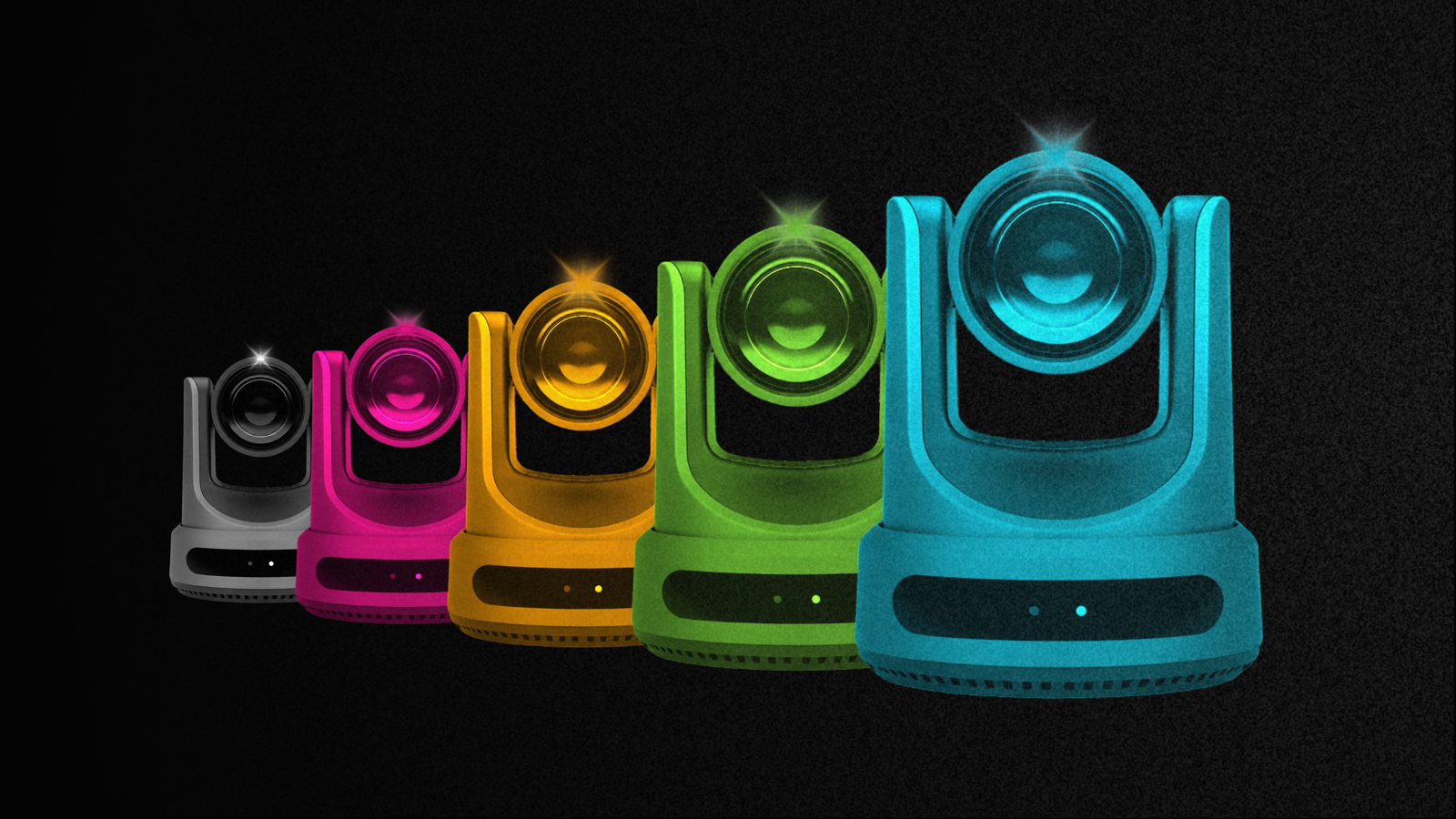
Author Studio Archive.
EDUCATIONAL REFERENCE & INDUSTRY LEXICON

Pro-AV, Broadcast & Robotic Camera Encyclopedia (100 Key Terms)

TERM #001 Optics & Sensors Ch. 4, 11

Parfocal vs. Varifocal Zoom Lens

SPEC / FORMULA: f = 4.1–98.9mm (Parfocal)

How It Works: A true parfocal broadcast zoom lens maintains exact optical focus on the subject throughout the entire zoom range from wide to telephoto. Most compact PTZ block cameras use a varifocal 4-group internal design where a microprocessor must continuously move a 'compensator/focus' lens group along a stored cam curve in memory while the 'variator' group zooms.

💡 Why It Matters in AV & Broadcast: If a varifocal PTZ camera's focus lookup curve is slightly miscalibrated or hunting in low light, zooming in live on-air causes momentary blur—which is why broadcast PTZs use Zoom Trigger AF or phase-detection AF tracking curves.

Historical Era: Ch. 4, 11
TERM #002 Optics & Sensors Ch. 4

Block Camera (OEM Camera Module)

SPEC / FORMULA: Sony FCB / Hitachi VK-S (230g)

How It Works: A self-contained, rectangular internal camera unit that integrates the motorized optical zoom lens, auto-iris, image sensor, DSP image processor, and TTL serial control port into a single palm-sized module (typically 50 × 57 × 89 mm).

💡 Why It Matters in AV & Broadcast: Pioneered by Sony (FCB series) and Hitachi (VK-S series) in the late 1990s, OEM block cameras allowed security dome and Pro-AV PTZ manufacturers worldwide to buy a pre-aligned 18× to 36× optical engine and mount it inside their own pan-tilt mechanisms via a 30-pin KEL micro-coax ribbon.

Historical Era: Ch. 4
TERM #003 Optics & Sensors Ch. 4, 14, 17

Sensor Format & Crop Factor (1/4" to 35mm Full-Frame)

SPEC / FORMULA: 1/4" (9.7mm²) → FF (847.3mm²)

How It Works: The physical active silicon area of the camera's image sensor. Traditional security domes used 1/4-inch (3.6 × 2.7 mm, 9.7 mm²) chips; standard Pro-AV HD PTZs use 1/2.8-inch (19.4 mm²); broadcast 4K flagships use 1.0-inch (13.2 × 8.8 mm, 116.2 mm²); and cinema PTZs (Sony ILME-FR7) use 35mm Full-Frame (35.6 × 23.8 mm, 847.3 mm²).

💡 Why It Matters in AV & Broadcast: A 35mm full-frame sensor has 87× the surface area of a 1/4-inch chip and 43× the area of a 1/2.8-inch chip. Smaller sensors enable compact, lightweight 30× zoom lenses with deep focus; larger sensors gather dramatically more photons in the dark and create shallow, cinematic background blur (bokeh).

Historical Era: Ch. 4, 14, 17
TERM #004 Optics & Sensors Ch. 14

Depth of Field (DOF) & Bokeh

SPEC / FORMULA: DOF ∝ (N · c · d²) / f²

How It Works: Depth of field is the front-to-back distance zone in a scene that appears acceptably sharp; 'bokeh' (from the Japanese word for blur) describes the aesthetic quality of out-of-focus background highlights.

💡 Why It Matters in AV & Broadcast: Because a 1/2.8-inch PTZ camera uses a tiny 4mm physical focal length at wide angle, everything from 1 meter to infinity is in clinical focus. Achieving shallow cinema bokeh requires a longer physical focal length and wider entrance pupil on a 1.0-inch or 35mm full-frame sensor.

Historical Era: Ch. 14
TERM #005 Optics & Sensors Ch. 4, 14, 17

Entrance Pupil Diameter & F-Number (f-stop)

SPEC / FORMULA: D_pupil = f / N

How It Works: The f-number (N = f / D) is the ratio of a lens's physical focal length (f) to the diameter of its entrance pupil (D). As a compact PTZ zoom lens zooms from wide to telephoto, its maximum aperture typically 'ramps' (darkens) from f/1.6 at wide angle to f/4.5 or f/5.2 at full telephoto.

💡 Why It Matters in AV & Broadcast: Aperture ramping means a PTZ camera loses 2 to 3 stops of light when zoomed all the way in from the back of an auditorium—requiring higher ISO gain or brighter stage lighting at telephoto reach.

Historical Era: Ch. 4, 14, 17
TERM #006 Optics & Sensors Ch. 17

Airy Disk Diffraction Limit

SPEC / FORMULA: d_Airy = 2.44 · λ · N

How It Works: Because light is a wave (wavelength λ ≈ 0.55 μm for green light), passing through a circular lens aperture of f-number N causes light waves to diffract into a microscopic bullseye blur spot called the Airy disk.

💡 Why It Matters in AV & Broadcast: At f/8, the Airy disk is 10.74 μm wide. On a 410-megapixel sensor with 1.5 μm pixels (Canon LI8030SA), stopping the lens down to f/8 blurs a single point of light across a 7×7 grid (49 pixels), setting a hard physical ceiling on solid-state digital PTZ resolution.

Historical Era: Ch. 17
TERM #007 Optics & Sensors Ch. 14, 17

Photon Shot Noise & Full-Well Capacity

SPEC / FORMULA: SNR_max = √(N_well)

How It Works: Photons arrive at a pixel randomly according to Poisson statistics, creating 'shot noise' equal to the square root of the photon count. Full-well capacity is the maximum number of electrons a single photodiode pixel can hold before saturating (clipping to pure white).

💡 Why It Matters in AV & Broadcast: A 1.5 μm pixel (Canon 410MP LI8030SA) holds ~3,900 electrons, whereas an 8.4 μm pixel (Sony 10.3MP Full-Frame FR7) has 31× more surface area and holds >40,000 electrons—giving large-pixel cinema PTZs 15+ stops of dynamic range and clean ISO 12,800 low-light performance.

Historical Era: Ch. 14, 17
TERM #008 Optics & Sensors Ch. 10

3-CCD Dichroic Prism Block vs. Single-Chip Bayer

SPEC / FORMULA: R-G-B Beam-Splitter Prism

How It Works: A single-chip CMOS sensor uses a microscopic Bayer color filter mosaic over its pixels, absorbing roughly two-thirds of incoming light and interpolating color. A 3-CCD / 3-CMOS broadcast block (Sony BRC-300/H700, Panasonic AW-HE100) uses a glass dichroic prism to split light into separate Red, Green, and Blue optical beams aimed at three dedicated sensors.

💡 Why It Matters in AV & Broadcast: Three-chip prism optics eliminated color moiré and delivered true broadcast color fidelity in the 2000s before large back-illuminated 4K CMOS sensors closed the light-gathering gap.

Historical Era: Ch. 10
TERM #009 Optics & Sensors Ch. 14, 16, 17

Back-Illuminated (BSI) & Stacked CMOS (Exmor R / RS)

SPEC / FORMULA: Photodiode Above Wiring Layer

How It Works: In conventional front-illuminated CMOS sensors, metal wiring sits in front of the photodiode, blocking light. Back-Illuminated (BSI / Exmor R) sensors flip the silicon wafer so light strikes the photodiode unobstructed; 'Stacked' CMOS (Exmor RS / Canon LI8030SA) bonds a high-speed logic processor wafer directly underneath the pixel wafer.

💡 Why It Matters in AV & Broadcast: Stacked BSI sensors roughly double low-light sensitivity while enabling ultra-fast readout (3,280 megapixels/sec on Canon's 410MP chip and 4K120p with minimal rolling shutter on Sony's FR7 and BRC-AM7).

Historical Era: Ch. 14, 16, 17
TERM #010 Optics & Sensors Ch. 14, 17

Rolling Shutter Skew vs. Global Shutter

SPEC / FORMULA: Row-by-Row vs. Simultaneous Readout

How It Works: A rolling-shutter CMOS sensor reads pixel rows sequentially from top to bottom over 8 to 16 milliseconds; if a PTZ camera whips at 300°/sec, vertical stadium goalposts tilt diagonally ('jello effect'). A global-shutter sensor exposes and reads every pixel at the exact same microsecond.

💡 Why It Matters in AV & Broadcast: Fast-reading stacked CMOS sensors and global-shutter broadcast sensors prevent geometric skew during rapid pan moves and eliminate partial-frame banding under pulsed LED stage walls.

Historical Era: Ch. 14, 17
TERM #011 Optics & Sensors Ch. 14, 16

Optical Low-Pass Filter (OLPF) & LED Wall Moiré

SPEC / FORMULA: Birefringent Quartz Anti-Aliasing

How It Works: An optical filter placed directly in front of the image sensor (e.g., Panasonic AW-UE160, Sony BRC-AM7) that splits light rays by a sub-pixel distance to prevent high-frequency spatial detail from exceeding the sensor's Nyquist sampling limit.

💡 Why It Matters in AV & Broadcast: Essential when filming presenters standing in front of fine-pitch LED virtual-production walls or wearing pinstriped suits, where an unfiltered sensor creates swirling rainbow moiré interference patterns.

Historical Era: Ch. 14, 16
TERM #012 Optics & Sensors Ch. 14, 16

Linear Variable Electronic ND Filter (1/4 to 1/128)

SPEC / FORMULA: 2 to 7 Stops Liquid-Crystal ND

How It Works: A voltage-controlled liquid-crystal optical filter built behind the lens mount (Sony ILME-FR7, BRC-AM7) whose light transmittance can be adjusted seamlessly from 1/4 (2 stops) to 1/128 (7 stops) by remote control.

💡 Why It Matters in AV & Broadcast: Allows a broadcast operator to adjust exposure smoothly as stage lighting changes without closing the lens iris—preserving a constant wide-open f/2.8 or f/4.0 aperture for shallow cinematic depth of field.

Historical Era: Ch. 14, 16
TERM #013 Optics & Sensors Ch. 14

Dual Base ISO (ISO 800 / 12,800)

SPEC / FORMULA: Dual Conversion Gain Photodiodes

How It Works: A sensor circuit design (used in Sony's ILME-FR7) that provides two distinct native analog conversion-gain circuits at each pixel: a high-well-capacity circuit at ISO 800 for daylight/bright studios, and a high-gain low-read-noise circuit at ISO 12,800 for dark stages.

💡 Why It Matters in AV & Broadcast: Switching to the high base ISO 12,800 in a dimly lit concert hall or reality-TV bedroom yields a clean, virtually noiseless image comparable to ISO 800.

Historical Era: Ch. 14
TERM #014 Optics & Sensors Ch. 4, 14, 16

Contrast-Detection AF vs. Phase-Detection AF (PDAF / Dual Pixel)

SPEC / FORMULA: Hill-Climbing vs. Phase-Split Rays

How It Works: Contrast-detection AF (used in 1990s–2000s block cameras) rocks the focus lens back and forth searching for peak high-frequency edge contrast—causing visible 'focus hunting.' Phase-Detection AF (627-point Fast Hybrid AF on Sony FR7; Dual Pixel CMOS AF on Canon CR-N700) splits light rays on the sensor to calculate exact focus distance and direction in one step.

💡 Why It Matters in AV & Broadcast: On-sensor PDAF with Real-Time Human Eye-AF locks focus onto a moving presenter's pupil instantly without ever overshooting or pumping the focus barrel.

Historical Era: Ch. 4, 14, 16
TERM #015 Optics & Sensors Ch. 4, 6

Zoom Trigger AF & Interval AF (VISCA 0x57)

SPEC / FORMULA: VISCA: 8x 01 04 57 02 FF

How It Works: Specialized firmware autofocus modes invented by Sony for FCB block cameras. Instead of leaving continuous Normal AF running (which hunts endlessly on flashing casino slot machines or passing cars), Zoom Trigger AF activates autofocus for 5 seconds after a zoom or pan move stops, then locks the lens in Manual Focus (MF).

💡 Why It Matters in AV & Broadcast: Saved millions of security dome focus motors from premature burnout and kept surveillance/broadcast shots rock-steady during static holds.

Historical Era: Ch. 4, 6
TERM #016 Optics & Sensors Ch. 11, 14, 15

Clear Image Zoom (CIZ) & Hybrid Super-Resolution Zoom

SPEC / FORMULA: 1.5× (4K) / 2.0× (HD) Oversampled

How It Works: Unlike crude digital zoom (which simply crops and enlarges pixels, causing blocky aliasing), super-resolution zoom combines sensor oversampling (e.g., reading a 5K or 50MP sensor to output 4K) with multi-frame pattern-matching interpolation.

💡 Why It Matters in AV & Broadcast: Extends a 20× optical zoom PTZ to 30× in 4K or 40× in HD (Sony BRC-AM7 / SRG-A40) with virtually no perceptible loss of broadcast sharpness.

Historical Era: Ch. 11, 14, 15
TERM #017 Optics & Sensors Ch. 3, 4

Dome Bubble Refraction & Tilt Horizon Astigmatism

SPEC / FORMULA: 2–3mm Acrylic/Polycarbonate Hemisphere

How It Works: An optically molded acrylic (PMMA) or polycarbonate hemisphere protects ceiling dome cameras, but acts as a negative diverging meniscus lens. When a high-zoom block camera tilts above 60° near the dome's horizontal equator, light rays pass obliquely through varying plastic thickness.

💡 Why It Matters in AV & Broadcast: Causes astigmatic blur at long telephoto zoom—which led broadcast and outdoor designers to replace hemispherical bubbles with flat optical glass windows traveling with the lens barrel.

Historical Era: Ch. 3, 4
TERM #018 Motors & Kinematics Ch. 3, 5, 11

Stepper Motor & Micro-Stepping Belt Drive

SPEC / FORMULA: 1.8° Full Step ÷ 256 Micro-Steps

How It Works: A brushless synchronous electric motor that divides a full 360° rotation into discrete angular steps (typically 200 full steps of 1.8°). By varying sinusoidal current across two stator windings ('micro-stepping') and coupling the shaft to a cogged neoprene timing belt, engineers divide each step into hundreds of sub-steps.

💡 Why It Matters in AV & Broadcast: The workhorse drive of 90% of commercial PTZ cameras—offering open-loop positional counting without expensive optical encoders, though prone to audible resonance ('stepper whine') and step-loss if physically bumped.

Historical Era: Ch. 3, 5, 11
TERM #019 Motors & Kinematics Ch. 5, 11

Gearless Brushless Direct Drive (D.D. Motor)

SPEC / FORMULA: 0.000° Backlash · NC25 Quietness

How It Works: An electromagnetic drive architecture (pioneered in miniature on Sony's 1996 EVI-G20 and scaled to heavy broadcast heads in Panasonic's 2020 AW-UE100 and AW-UE160) where a multi-pole copper stator ring directly rotates a permanent-magnet rotor attached to the pan/tilt shaft with zero gears or belts.

💡 Why It Matters in AV & Broadcast: Eliminates gear tooth backlash (0.000° dead zone), mechanical wear, and gear whine—allowing ultra-slow 0.004°/s to 0.08°/s telephoto creeps at NC25 studio silence alongside 300°/s preset whips.

Historical Era: Ch. 5, 11
TERM #020 Motors & Kinematics Ch. 11

Gear Backlash (Mechanical Lash / Deadband)

SPEC / FORMULA: 0.10° Lash = 116 Pixels @ 24× 4K

How It Works: The microscopic clearance gap between mating worm and spur gear teeth required for lubrication and thermal expansion. When an operator reverses joystick direction from left to right, the motor shaft must spin across that empty gap before the output ring gear moves.

💡 Why It Matters in AV & Broadcast: At 24× telephoto zoom on a 4K sensor (where the horizontal field of view is only 3.3°, or 1,163 pixels per degree), a tiny 0.10° backlash gap causes a jarring 116-pixel jump on screen when starting or reversing a move.

Historical Era: Ch. 11
TERM #021 Motors & Kinematics Ch. 1

Harmonic Drive (Strain-Wave Gearing)

SPEC / FORMULA: 80:1 Zero-Backlash Flexspline

How It Works: Invented by C. Walton Musser in 1957 and used in RCA's 1971 Apollo Lunar Rover GCTA camera (NAS 9-11260), a strain-wave gear uses an elliptical wave generator inside a flexible toothed cup ('flexspline') meshing with a rigid circular spline.

💡 Why It Matters in AV & Broadcast: Provides massive gear reduction (80:1 to 160:1) in a tiny, lightweight package with virtually zero backlash and high holding torque in the vacuum of space.

Historical Era: Ch. 1
TERM #022 Motors & Kinematics Ch. 3

Slip Ring Capsule (360° Continuous Rotation)

SPEC / FORMULA: 12–24 Concentric Gold-on-Gold Rings

How It Works: An electromechanical rotary joint mounted along the vertical pan axis of a ceiling dome or gimbal (`Sensormatic SpeedDome US 5,223,872`, `Pelco Spectra`) consisting of stationary precious-metal brush wipers ('stator') riding against concentric gold-alloy rings ('rotor').

💡 Why It Matters in AV & Broadcast: Allows a PTZ dome or gimbal to spin 360° continuously in the same direction without ever twisting, snagging, or snapping internal power, coax video, and serial telemetry wires.

Historical Era: Ch. 3
TERM #023 Motors & Kinematics Ch. 15

PTZR (Pan-Tilt-Zoom-Rotate 3-Axis Gimbal)

SPEC / FORMULA: Axis 3: Roll ±120° (90° Vertical 4K60)

How It Works: Introduced commercially on Remo Tech's March 2025 OBSBOT Tail 2 (`OAB-2305-CW`), a PTZR camera adds a third motorized brushless Roll ('Rotate') axis to the traditional 2-axis Pan and Tilt yoke.

💡 Why It Matters in AV & Broadcast: Allows the camera to physically rotate its entire lens-and-sensor barrel by 90° on command to shoot native, uncropped 4K60 vertical (9:16) video for mobile/social feeds, while also providing active ±0.003° horizon auto-leveling.

Historical Era: Ch. 15
TERM #024 Motors & Kinematics Ch. 3, 11

ZAP (Zoom Adjusted Programming / Proportional Speed)

SPEC / FORMULA: ω_pan(Z) = ω_max / Z (US 5,801,770)

How It Works: Patented by Sensormatic (EP 0525482 / US 5,801,770), ZAP continuously reads the zoom lens encoder and divides the joystick's pan and tilt angular velocity in inverse proportion to the optical zoom magnification.

💡 Why It Matters in AV & Broadcast: Without proportional speed scaling, a 100°/sec pan that looks comfortable at 1× wide angle (50° FOV) becomes an unwatchable 50-screen-widths-per-second blur at 25× telephoto zoom (2° FOV).

Historical Era: Ch. 3, 11
TERM #025 Motors & Kinematics Ch. 11

PTZ Motion Sync & S-Curve Velocity Ramps

SPEC / FORMULA: VISCA Ramp Curve: 8x 01 06 31 0p FF

How It Works: Two essential broadcast motion algorithms: (1) S-Curve Ramping feathers motor acceleration and deceleration smoothly at the start and end of a move instead of jerking abruptly; (2) PTZ Motion Sync dynamically scales Pan, Tilt, and Zoom speeds during a preset recall so all three axes start and finish at the exact same millisecond.

💡 Why It Matters in AV & Broadcast: Eliminates the robotic 'stair-step' or 'hockey-stick' trajectory where a camera finishes tilting up in 1 second and then drags horizontally across the wall for another 2 seconds.

Historical Era: Ch. 11
TERM #026 Motors & Kinematics Ch. 11, 16

PTZ Trace Memory (Trajectory Macro Recording)

SPEC / FORMULA: 16 Slots × Up to 180 Seconds

How It Works: Unlike a standard Preset (which only remembers a single static XYZ destination point), Trace Memory (`Sony BRC-X1000`, `Panasonic AW-UE150`) records the continuous, second-by-second pan, tilt, zoom, and focus path performed by a human operator on the joystick during rehearsal.

💡 Why It Matters in AV & Broadcast: Allows a solo live-production operator to replay complex, human-paced crane-like camera moves on air with a single button press.

Historical Era: Ch. 11, 16
TERM #027 Motors & Kinematics Ch. 3, 6, 10

Nadir Auto-Flip (180° Proportional Dome Flip)

SPEC / FORMULA: 0.25s 180° Pan Spin at -90° Tilt

How It Works: When a ceiling-mounted dome camera tilts straight down (-90° nadir) to follow a person walking directly underneath it, it hits its mechanical tilt stop. Auto-Flip automatically spins the pan axis 180° in a quarter-second (and inverts image/joystick polarity on 'Smart Flip' models) so the tilt move can continue smoothly up the other side.

💡 Why It Matters in AV & Broadcast: Solved the 'under-the-camera blind spot' in retail aisles, casinos, and reality-TV houses.

Historical Era: Ch. 3, 6, 10
TERM #028 Motors & Kinematics Ch. 11

Hybrid OIS + Roll EIS Image Stabilization

SPEC / FORMULA: Optical Gyro Prism + Digital Roll Shift

How It Works: A two-stage stabilization system (`Panasonic AW-UE100 / UE160`): an internal gyroscope drives a floating optical lens group (`OIS`) to cancel high-frequency pitch and yaw vibration, while real-time electronic frame shifting (`EIS`) counter-rotates the image around the optical axis to cancel roll vibration.

💡 Why It Matters in AV & Broadcast: Keeps long-telephoto 4K shots rock-steady when PTZ cameras are mounted on vibrating concert lighting trusses, stadium scoreboards, or footsteps-prone balcony rails.

Historical Era: Ch. 11
TERM #029 Motors & Kinematics Ch. 10, 11, 14, 16

NC Rating (Noise Criteria: NC25, NC30, NC35)

SPEC / FORMULA: Octave-Band Acoustic Pressure Floor

How It Works: The architectural acoustics standard measuring steady-state mechanical fan and motor noise across octave frequency bands from 63 Hz to 8,000 Hz. NC35 is audible in a quiet room; NC30 (2008 Panasonic AW-HE100) is suitable for TV studios; NC25 (2020 AW-UE100 / 2024 Sony BRC-AM7) is virtually silent.

💡 Why It Matters in AV & Broadcast: Achieving NC25 required fanless convection heatsinks and gearless direct-drive motors so cameras could be mounted six feet above symphony violinists, classical stages, and hospital beds.

Historical Era: Ch. 10, 11, 14, 16
TERM #030 Motors & Kinematics Ch. 14

Slide-Base Balancing & 15mm LWS Rod Support

SPEC / FORMULA: Sony ILME-FR7 Scale (0.5 to 5.0+)

How It Works: Because an interchangeable-lens PTZ camera (`Sony ILME-FR7`) can carry a lightweight 16–35mm wide lens one day and a heavy 6.0-kg 28–135mm or 70–200mm cinema zoom the next, its center of gravity shifts dramatically. The camera head mounts on a numbered fore-and-aft sliding balance plate with a mechanical tilt-lock lever and twin 15mm Lightweight Standard (`LWS`) support rods.

💡 Why It Matters in AV & Broadcast: Proper horizontal seesaw balancing prevents front-heavy cinema lenses from overloading the tilt motor or nose-diving when power is removed.

Historical Era: Ch. 14
TERM #031 Motors & Kinematics Ch. 10, 13, 16, 18

Tally Light System (Red Program / Green Preview & AI)

SPEC / FORMULA: Red = On-Air PGM | Green = AI Auto-Frame

How It Works: High-visibility LEDs mounted on the front bezel of a studio camera. Traditionally, Red indicates the camera is live on-air (`Program / PGM`) and Green/Amber indicates `Preview (PVW)`. In 2023–2024 (`Sony SRG-A40`, `BRC-AM7`), manufacturers added a dedicated Green Tally mode to indicate when on-board AI Auto-Framing is actively tracking a human.

💡 Why It Matters in AV & Broadcast: Serves as both an operational cue for talent eye-contact and a vital ethical transparency signal in automated rooms.

Historical Era: Ch. 10, 13, 16, 18
TERM #032 Control Protocols Ch. 6

Sony VISCA Protocol (RS-232C / RS-422)

SPEC / FORMULA: 8x 01 06 01 VV WW 0p 0q FF (9600 bps)

How It Works: Introduced by Sony in 1991 with the CI-1000 Vbox (`Video System Control Architecture`), VISCA is a stateful, packet-based serial control protocol framed by a header byte (`0x81` to `0x87` for cameras 1–7, `0x88` for broadcast) and terminated by `0xFF`.

💡 Why It Matters in AV & Broadcast: Became the universal lingua franca of OEM block cameras, videoconferencing PTZs, and broadcast robotics—supporting daisy-chaining up to 7 cameras via 8-pin Mini-DIN cables and explicit two-step command handshaking.

Historical Era: Ch. 6
TERM #033 Control Protocols Ch. 6

VISCA 2-Socket Buffer: ACK (90 4y FF) & Completion (90 5y FF)

SPEC / FORMULA: ACK = Queued | Completion = Arrived

How It Works: Unlike blind serial protocols, a VISCA camera maintains two internal command execution sockets (`y = 1` or `2`). When a controller sends a Pan-Tilt command, the camera immediately replies `90 41 FF` (`ACK`: command accepted into Socket 1), and only sends `90 51 FF` (`Completion`) several seconds later when the physical motors finish the move.

💡 Why It Matters in AV & Broadcast: Allows computerized studio automation systems to know the exact millisecond a preset or zoom move has physically settled before cutting the camera to air.

Historical Era: Ch. 6
TERM #034 Control Protocols Ch. 6, 13

VISCA-over-IP (UDP Port 52381 / 1259 & TCP 5678)

SPEC / FORMULA: 8-Byte Seq Header + Raw VISCA Payload

How It Works: Wraps standard hexadecimal VISCA command bytes inside an Ethernet UDP or TCP packet. Sony's broadcast implementation prepends an 8-byte header (Payload Type `0x0100`, Payload Length, and a 32-bit incrementing Sequence Number) on UDP port `52381`, while Pro-AV challengers (`PTZOptics`, `Lumens`, `Minrray`) also support raw headerless VISCA over UDP `1259` and TCP `5678`.

💡 Why It Matters in AV & Broadcast: Allowed legacy serial joystick logic to transition onto standard gigabit IP switches and power modern Stream Deck / OBS software controllers.

Historical Era: Ch. 6, 13
TERM #035 Control Protocols Ch. 6

Pelco-D Protocol (7-Byte RS-485 Frame)

SPEC / FORMULA: FF [Addr] [Cmd1] [Cmd2] [Pan] [Tilt] [Chk]

How It Works: Developed by Pelco in the mid-1990s for the Spectra dome (`Standard TF-0002`), Pelco-D is a compact, 7-byte, one-way serial protocol running at 2400–9600 baud over differential RS-485 twisted pair: Byte 1 is always `0xFF` (Sync), Byte 2 is Camera Address (`1–254`), Bytes 3–4 are bit-mapped function flags, Bytes 5–6 are Pan/Tilt speeds (`0x00–0x3F`), and Byte 7 is the Modulo-256 sum of Bytes 2–6.

💡 Why It Matters in AV & Broadcast: Because it requires no two-way handshake, a single Pelco-D keypad can broadcast over a mile of cheap 2-wire twisted pair to 254 security domes in harsh electrical environments.

Historical Era: Ch. 6
TERM #036 Control Protocols Ch. 6

Preset 95 (Co-Opted Pelco-D OSD Menu Command)

SPEC / FORMULA: Hex: FF 01 00 03 00 5F 63

How It Works: A famous piece of engineering ingenuity in Pelco's D-Protocol specification (`Section 5.2.2`): because 1980s/1990s CCTV matrix keyboards had numeric keypads (`0–9`, `Preset`, `Pattern`) but no `MENU` button, Pelco firmware engineers hijacked `Set Preset 95` (`0x5F`) to pop open the camera's internal On-Screen Display (`OSD`) setup menu.

💡 Why It Matters in AV & Broadcast: Once inside the Preset 95 OSD menu, technicians used the pan/tilt joystick to move the cursor up and down, `Iris Open` to select, and `Iris Close` to exit!

Historical Era: Ch. 6
TERM #037 Control Protocols Ch. 2

Coaxitron (Line-18 VBI Up-the-Coax Telemetry)

SPEC / FORMULA: 15-Bit / 32-Bit 333 kHz PWM on Line 18

How It Works: Pelco's single-cable analog telemetry protocol (`coaxspec121602revC`). While analog NTSC video flowed downstream from the camera to the monitor during active scanning lines (`Lines 21–262.5`), the controller waited for the 1.27-millisecond Vertical Blanking Interval (`VBI`) between video fields and fired a 1-Volt, 333-kHz pulse-width-modulated (`PWM`) command burst upstream on **Video Line 18**.

💡 Why It Matters in AV & Broadcast: Eliminated separate control wires on coaxial runs up to 750 feet on RG-59/U or 1,500 feet on RG-11/U.

Historical Era: Ch. 2
TERM #038 Control Protocols Ch. 2

AD Manchester Control Code

SPEC / FORMULA: 5,000-Foot Self-Clocking Twisted Pair

How It Works: Developed by Victor Houk's team at American Dynamics (Orangeburg, NY) for the AD2150 and MegaPower 168 matrix switchers, Manchester encoding embeds the clock signal into every data bit via mid-bit voltage phase transitions (High-to-Low = 1; Low-to-High = 0).

💡 Why It Matters in AV & Broadcast: Immune to DC voltage drift and polarity reversal, allowing a single 18-AWG twisted pair to daisy-chain PTZ receivers nearly a mile (5,000 feet / 1.5 km) away.

Historical Era: Ch. 2
TERM #039 Control Protocols Ch. 9

ONVIF (Profiles S, T, M & Normalized Coordinate Space)

SPEC / FORMULA: GenericPanTiltPositionSpace ∈ [-1.0, +1.0]

How It Works: Founded in May 2008 by Axis, Bosch, and Sony (`Open Network Video Interface Forum`), ONVIF standardized IP camera discovery (`WS-Discovery`), streaming, and PTZ control using XML/SOAP web services. Its `PTZNode` specification maps every camera's physical pan and tilt limits onto a universal floating-point scale from `-1.0` to `+1.0`, and zoom from `0.0` to `1.0`.

💡 Why It Matters in AV & Broadcast: Ended the $20,000-per-camera custom driver wars, defeating rival alliance PSIA and enabling any Video Management System (`Milestone`, `Genetec`) to steer any brand of IP PTZ camera out of the box.

Historical Era: Ch. 9
TERM #040 Control Protocols Ch. 6, 8, 13

HTTP-CGI Query Control (/cgi-bin/ptzctrl.cgi)

SPEC / FORMULA: GET /cgi-bin/ptzctrl.cgi?ptzcmd&up&10&10

How It Works: A REST-like control interface embedded in the internal web server of network PTZ cameras (`Axis /axis-cgi/com/ptz.cgi`, `PTZOptics /cgi-bin/ptzctrl.cgi`, `Sony /command/ptzf.cgi`) that accepts human-readable URL query strings over standard HTTP/HTTPS port 80/443.

💡 Why It Matters in AV & Broadcast: Made it trivial for web developers, Crestron/Extron programmers, and open-source automation tools to trigger camera moves from any browser or script.

Historical Era: Ch. 6, 8, 13
TERM #041 Control Protocols Ch. 12

USB Video Class (UVC 1.0–1.5 Camera Terminal 0x0B–0x0E)

SPEC / FORMULA: CT_PANTILT_ABSOLUTE_CONTROL (0x0D)

How It Works: Ratified by the USB Implementers Forum on September 4, 2003, the UVC standard defines built-in OS-level descriptors (`Section A.9.4`) for mechanical PTZ cameras over a single USB cable—including `0x0B` (Absolute Zoom in millimeters) and `0x0D` (`CT_PANTILT_ABSOLUTE_CONTROL`, an 8-byte signed integer payload specifying Pan and Tilt in **arc-seconds**, or 1/3,600th of a degree).

💡 Why It Matters in AV & Broadcast: Allowed Windows, macOS, Linux, Zoom, and Microsoft Teams to natively pan, tilt, and zoom USB conference cameras (`Logitech Orbit`, `HuddleCamHD`, `AVer`, `OBSBOT Tiny`) with zero proprietary drivers.

Historical Era: Ch. 12
TERM #042 Control Protocols Ch. 6, 13

Bitfocus Companion & Elgato Stream Deck

SPEC / FORMULA: Open-Source Multi-Protocol Macro Matrix

How It Works: Launched in 2018, Bitfocus Companion is an open-source node.js control server that turns physical LCD-key Elgato Stream Deck pads into universal broadcast macro controllers—translating a single button press into simultaneous `VISCA-over-IP`, `HTTP-CGI`, `ONVIF`, `vMix`, `OBS`, and `Blackmagic ATEM` commands.

💡 Why It Matters in AV & Broadcast: Replaced $5,000 proprietary hardware panels in thousands of churches, schools, and creator studios.

Historical Era: Ch. 6, 13
TERM #043 AV-over-IP & Power Ch. 13

NewTek NDI (Full High-Bandwidth NDI vs. NDI|HX / HX3)

SPEC / FORMULA: Full NDI (~140 Mbps) vs. NDI|HX3 (~20 Mbps)

How It Works: Unveiled by NewTek CTO Dr. Andrew Cross on September 8, 2015, Network Device Interface (`NDI`) transports video, audio, tally, and PTZ control over standard Gigabit Ethernet with automatic `mDNS` (`_ndi._tcp.local`) discovery. **Full NDI** (pioneered in PTZs by BirdDog in 2018 using custom FPGA silicon) uses intra-frame `SpeedHQ` (~140 Mbps for 1080p60, ~1–2 ms latency); **NDI|HX / HX3** (launched on PTZs by PTZOptics and Panasonic in 2017) uses compressed `H.264/HEVC` (~12–25 Mbps, ~16–33 ms latency).

💡 Why It Matters in AV & Broadcast: Allowed a single Cat6 network switch to replace miles of point-to-point coaxial SDI cables and hardware video routers.

Historical Era: Ch. 13
TERM #044 AV-over-IP & Power Ch. 13, 14, 15

SRT (Secure Reliable Transport)

SPEC / FORMULA: UDP + ARQ Packet Recovery + AES-256

How It Works: An open-source video transport protocol developed by Haivision that wraps compressed video streams in UDP packets with Automatic Repeat Request (`ARQ`) lost-packet retransmission, jitter buffering, and `AES-256` encryption.

💡 Why It Matters in AV & Broadcast: While NDI is designed for low-latency local area networks (`LANs`), SRT allows a remote PTZ camera in another city or stadium to stream broadcast-grade 4K video cleanly across the unpredictable public Internet (`WAN`) to a central control room.

Historical Era: Ch. 13, 14, 15
TERM #045 AV-over-IP & Power Ch. 13, 14

SMPTE ST 2110 & IEEE 1588 PTPv2

SPEC / FORMULA: Uncompressed IP Video (`ST 2110-20` + `2110-40`)

How It Works: The tier-one broadcast television IP standard (`Panasonic AW-UE160`) that transports uncompressed video (`ST 2110-20`), uncompressed audio (`ST 2110-30`), and ancillary metadata (`ST 2110-40`) as separate multicast IP streams synchronized to the nanosecond by `IEEE 1588 Precision Time Protocol (PTPv2)`.

💡 Why It Matters in AV & Broadcast: Lets each department in a major television network route video, audio, and tracking metadata independently with zero compression latency.

Historical Era: Ch. 13, 14
TERM #046 AV-over-IP & Power Ch. 10, 13, 14

3G-SDI, 6G-SDI & 12G-SDI (Serial Digital Interface)

SPEC / FORMULA: 12G-SDI = 11.88 Gbps Single-Coax 4K60

How It Works: The SMPTE coaxial broadcast video family over 75-ohm BNC connectors: `HD-SDI` (`1.485 Gbps`, 1080i), `3G-SDI` (`2.97 Gbps`, 1080p60), `6G-SDI` (4K30), and `12G-SDI` (`11.88 Gbps`, uncompressed 10-bit 4:2:2 `4K60p` over a single coaxial cable).

💡 Why It Matters in AV & Broadcast: Remains the rock-solid, zero-latency physical backbone of OB trucks and live arena switchers alongside IP outputs.

Historical Era: Ch. 10, 13, 14
TERM #047 AV-over-IP & Power Ch. 3, 10, 14

Genlock (Tri-Level Sync / Black Burst) & Line-Lock

SPEC / FORMULA: Sub-Microsecond Frame Alignment

How It Works: In analog CCTV (`Line-Lock`), cameras locked their 60/50 Hz vertical scan to the zero-crossing of the building's AC power wave. In professional broadcast (`Genlock`), an external master clock feeds `Black Burst` (SD) or `Tri-Level Sync` (HD/4K) into each PTZ camera's `GENLOCK IN` BNC port so every camera exposes Row 1 of Frame 1 at the exact same microsecond.

💡 Why It Matters in AV & Broadcast: Without Genlock, switching live between cameras causes a 1-frame buffer delay or visible tear, and virtual-studio `FreeD` graphics drift out of sync with the video field.

Historical Era: Ch. 3, 10, 14
TERM #048 AV-over-IP & Power Ch. 8, 13, 14

PoE, PoE+ & PoE++ (IEEE 802.3af / 802.3at / 802.3bt)

SPEC / FORMULA: 12.95W (PoE) → 25.5W (PoE+) → 71.3W (PoE++)

How It Works: The three generations of IEEE Power over Ethernet delivering 48–54V DC phantom power over Cat5e/Cat6 twisted-pair data cables: **802.3af (2003, PoE)** delivers `12.95W` assured at the camera; **802.3at (2009, PoE+)** doubles current to `25.5W` with Layer 2 `LLDP` negotiation; and **802.3bt (2018, PoE++ Type 3/4)** uses all four twisted pairs to deliver `51W` to `71.3W` at the camera.

💡 Why It Matters in AV & Broadcast: Early 12.95W PoE browned out when pan, tilt, and zoom motors accelerated simultaneously; 25.5W PoE+ unlocked the single-cable Pro-AV PTZ boom, and 71.3W PoE++ powers full-frame cinema robots (`Sony ILME-FR7`, `BRC-AM7`) and outdoor dome heaters.

Historical Era: Ch. 8, 13, 14
TERM #049 Virtual Production Ch. 14

FreeD Protocol (29-Byte 0xD1 Virtual Studio Packet)

SPEC / FORMULA: Byte 0 = 0xD1 | 6-DOF + Zoom/Focus + Chk

How It Works: Invented in September 1997 by BBC R&D engineer Graham A. Thomas (`EP 1015909`) and commercialized by Vinten Radamec, `FreeD` is a 29-byte binary packet (`Message Type 0xD1`) transmitted at 50/60 Hz over RS-422 or UDP/IP carrying Camera ID, 24-bit signed fixed-point Pan, Tilt, Roll (`degrees × 32,768`), X, Y, Z (`mm × 64`), 24-bit Zoom, 24-bit Focus, and a `0x40 - sum mod 256` checksum.

💡 Why It Matters in AV & Broadcast: Embedded into PTZ cameras starting with Panasonic's AW-UE150 (2018/2019), allowing a mounted PTZ camera (whose X, Y, Z position is fixed) to drive Unreal Engine (`LiveLinkFreeD`), Vizrt, and Brainstorm 3D virtual sets with zero external tracking hardware.

Historical Era: Ch. 14
TERM #050 Virtual Production Ch. 14

SMPTE-RIS OpenTrackIO

SPEC / FORMULA: Calibrated Physical Units in JSON / CBOR

How It Works: Developed in 2024–2025 by SMPTE Rapid Industry Solutions and supported natively in Unreal Engine 5.6+, `OpenTrackIO` is the modern open replacement for 1997 `FreeD`. Instead of sending raw, uncalibrated 24-bit encoder numbers (`0–4095`) for zoom and focus, it transmits real physical units (focal length in millimeters, focus distance in meters, T-stop, entrance-pupil offset, and polynomial lens distortion coefficients).

💡 Why It Matters in AV & Broadcast: Eliminates days of manual lens-lookup-table calibration when swapping E-mount lenses on a Sony ILME-FR7 virtual-production stage.

Historical Era: Ch. 14
TERM #051 Virtual Production Ch. 14

Target Seeking Camera (TSC) & Ceiling Barcode Rings

SPEC / FORMULA: 1mm Position / 0.01° Angle Accuracy (1997)

How It Works: The original 1997 BBC `free-d` hardware sensor: a small upward-facing auxiliary camera ringed with LEDs bolted at a 90° angle atop a studio pedestal camera, reading 20-cm concentric retro-reflective barcode rings hung above the studio lighting grid.

💡 Why It Matters in AV & Broadcast: Allowed pedestals and handheld cameras to roam across an 800-square-meter BBC election studio while feeding sub-millimeter 6-DOF coordinates into early virtual graphics computers.

Historical Era: Ch. 14
TERM #052 AI & Autonomy Ch. 15

Closed-Loop PTZ Delay Equation (τ = τ_m + τ_p + τ_c)

SPEC / FORMULA: τ = Motor + Processing + Network Delay

How It Works: Formulated by Chen, St-Charles, Bouachir, Joeisseint, Bilodeau, and Bergevin (Polytechnique Montréal & Univ. Laval, `arXiv:1505.04502`, May 2015), active PTZ tracking is governed by the sum of three delays: mechanical motor positioning delay (`τ_m`), vision algorithm processing delay (`τ_p`), and network/serial communication delay (`τ_c`).

💡 Why It Matters in AV & Broadcast: Because every motor move alters the pixels the camera sees in the next frame, a combined delay τ > 200 ms causes external-PC trackers to lag behind a walking human and oscillate—which is why moving neural networks onto an internal camera NPU (`τ_c = 0`) revolutionized auto-tracking.

Historical Era: Ch. 15
TERM #053 AI & Autonomy Ch. 15

Camshift (Continuously Adaptive Mean Shift)

SPEC / FORMULA: 1998 HSV Color-Histogram Tracker

How It Works: Published by Intel researcher Gary Bradski in 1998, `Camshift` tracks a moving subject by sampling the Hue-Saturation-Value (`HSV`) color histogram of an initial bounding box and shifting the window toward the peak color density in each new frame.

💡 Why It Matters in AV & Broadcast: Fast enough to run on 2000s CPUs (`τ_p ≈ 0`), but proved by Chen et al.'s 2015 `Ladybug 3` benchmark to suffer >80-pixel centering error (`TCE`) and >0.45 Track Fragmentation (`TF`) whenever a presenter walked past a similarly colored wall or podium.

Historical Era: Ch. 15
TERM #054 AI & Autonomy Ch. 15, 16

18-Keypoint Skeletal Pose Estimation & Re-ID

SPEC / FORMULA: Multi-Layer CNN (Skeleton + Face + Attire)

How It Works: Modern on-camera neural processors (`HiSilicon Hi3559A`, `Sony BIONZ XR + AI Analytics`) replace color blobs with deep convolutional neural networks that map 18 anatomical joints (head, shoulders, elbows, wrists, hips, knees, ankles) alongside registered facial biometrics and clothing fabric texture.

💡 Why It Matters in AV & Broadcast: Allows a camera (`Sony BRC-AM7`, `OBSBOT Tail 2`, `PTZOptics Move 4K`) to maintain continuous lock even when a professor turns their back to write on a chalkboard, wears a surgical mask, or crosses paths with another person on stage.

Historical Era: Ch. 15, 16
TERM #055 AI & Autonomy Ch. 16

Pan/Tilt Halting Area (Deadband Box)

SPEC / FORMULA: 0.00°/sec Motor Hold Zone (Canon RA-AT001)

How It Works: A configurable virtual bounding box drawn around the tracked presenter's silhouette (`Canon RA-AT001`, `PTZOptics Move 4K Tracking Sensitivity`). As long as the presenter remains inside the inner deadband box, the camera's pan and tilt motors remain 100% stationary (`0.00°/s`).

💡 Why It Matters in AV & Broadcast: The single most important guardrail for preventing 'seasick viewer syndrome'—stopping the camera from twitching left and right every time a lecturer shifts weight from foot to foot.

Historical Era: Ch. 16
TERM #056 AI & Autonomy Ch. 16

Auto Select Exclusion Area (Poster & Monitor Mask)

SPEC / FORMULA: Up to 4 Polygonal AI Blind Zones

How It Works: Polygonal masking zones configured in the camera's web UI (`Canon RA-AT001 Step 6`) where the neural network is forbidden from detecting or acquiring a human face or skeleton.

💡 Why It Matters in AV & Broadcast: Solves the infamous 'Wall Poster Trap'—preventing an autonomous camera from locking onto a photograph of a company founder, a church banner, or a television monitor on the stage wall when the real speaker exits.

Historical Era: Ch. 16
TERM #057 AI & Autonomy Ch. 16

Priority Display Area & Fixed Viewing Angle Area

SPEC / FORMULA: Whiteboard Anchor & Podium Freeze

How It Works: Two classroom and auditorium guardrails: (1) `Priority Display Area` designates a blackboard or projection screen that must remain inside the frame even as the camera pans to follow the professor; (2) `Fixed Viewing Angle Area` freezes all pan/tilt motion whenever the speaker stands behind the podium.

💡 Why It Matters in AV & Broadcast: Ensures remote students can finish copying equations off the board while keeping podium delivery rock-still.

Historical Era: Ch. 16
TERM #058 AI & Autonomy Ch. 16, 18

Lead Room Effect (Look-Room Compositional Framing)

SPEC / FORMULA: Dynamic Rule-of-Thirds Offset

How It Works: Instead of pinning a speaker's nose to the dead center of the crosshairs, compositional AI (`Sony BRC-AM7 Lead Room Effect`, `DJI ActiveTrack 6.0 Golden Spiral`, `Seervision`) detects the direction the subject is facing or walking and offsets the pan axis to leave 60% open breathing space ahead of their gaze.

💡 Why It Matters in AV & Broadcast: Replicates a fundamental rule of human broadcast cinematography automatically.

Historical Era: Ch. 16, 18
TERM #059 AI & Autonomy Ch. 7, 12, 16

TDOA (Time Difference of Arrival) Acoustic Beamforming

SPEC / FORMULA: Δt_ij = Δd / 343 m/s (1996 LimeLight → MXA920)

How It Works: Pioneered in PTZ conferencing by PictureTel's 4-microphone `LimeLight` array (`1997 IEEE ICASSP`) and modernized in ceiling array microphones (`Shure MXA920`, `Sennheiser TCC2`), TDOA measures the microsecond phase delay of a human voice arriving at multiple microphones to triangulate the speaker's 3D azimuth and elevation.

💡 Why It Matters in AV & Broadcast: Forms 'Rung 2' and 'Rung 5' of camera autonomy—telling the PTZ system *who* is speaking in a 20-person boardroom before the camera cuts.

Historical Era: Ch. 7, 12, 16
TERM #060 AI & Autonomy Ch. 12, 16

Dual-Camera Off-Air Switching (SpeakerTrack / EagleEye)

SPEC / FORMULA: Camera A Live | Camera B Slews @ 150°/s

How It Works: The signature telepresence architecture (`Polycom EagleEye Director`, `Cisco SpeakerTrack 60`) that mounts two PTZ cameras side-by-side. While Camera A broadcasts a steady close-up of Speaker 1, off-air Camera B slews rapidly at 150°/s to pre-frame and focus on Speaker 2, then executes a clean broadcast cut.

💡 Why It Matters in AV & Broadcast: Completely hides mechanical pan/tilt motion from remote meeting participants.

Historical Era: Ch. 12, 16
TERM #061 AI & Autonomy Ch. 16

Model Predictive Control (MPC — Seervision / ETH Zurich)

SPEC / FORMULA: Future-Horizon Trajectory Optimization

How It Works: Developed by Nikos Kariotoglou and Prof. John Lygeros at ETH Zurich's Automatic Control Laboratory (2016, acquired by Q-SYS in 2023), MPC replaces reactive PID loops with a mathematical model of human walking inertia that predicts where a presenter will decelerate 0.5 to 1.5 seconds in the future.

💡 Why It Matters in AV & Broadcast: Prevents robotic overshoot when a pacing lecturer stops at the edge of a stage, planning smooth S-curve moves and coordinating multiple cameras so two robots never chase the same shot.

Historical Era: Ch. 16
TERM #062 AI & Autonomy Ch. 16

End-to-End Deep Reinforcement Learning (UCLA Eagle)

SPEC / FORMULA: ~80K Params (90× Smaller than YOLOv5s)

How It Works: Presented by Sandha, Balaji, Garcia, and Srivastava at ACM/IEEE IoTDI '23 (`arXiv:2304.04356`), `Eagle` replaces the brittle 3-stage pipeline (`YOLO Object Detector → Kalman Filter → PID Controller`) with a single compact neural network trained via reinforcement learning in `EagleSim` (Unreal Engine + AirSim) that maps raw pixels directly to `(Pan, Tilt, Zoom)` motor actions.

💡 Why It Matters in AV & Broadcast: Runs at 33–38 FPS on a Raspberry Pi or Jetson Nano while achieving 17% longer continuous tracking duration than multi-stage trackers.

Historical Era: Ch. 16
TERM #063 AI & Autonomy Ch. 17

ePTZ (Solid-State Digital PTZ) & Multifocal Arrays

SPEC / FORMULA: Canon 410MP LI8030SA & Dallmeier Panomera

How It Works: Instead of moving physical motors, an `ePTZ` extracts and slides one or more 4K/HD crop windows (`ROIs`) across a stationary ultra-high-resolution sensor (`Canon 410MP 24K LI8030SA` = 49× 4K frames) or a multi-lens array of staggered focal lengths (`Dallmeier Panomera`, `EP 2715692`, guaranteeing `DIN EN 62676-4` ≥125–250 px/m across 325m).

💡 Why It Matters in AV & Broadcast: Delivers zero mechanical latency (`τ_m = 0`), zero acoustic noise (`NC0`), unlimited simultaneous virtual camera angles, and post-event 'time-travel' panning in recorded backups.

Historical Era: Ch. 17
TERM #064 AI & Autonomy Ch. 17, 18

Wearable Visual Robot & Socially Legible Gaze

SPEC / FORMULA: Oxford 3-Axis Shoulder Robot (2000–2004)

How It Works: Pioneered at the University of Oxford Active Vision Lab by Walterio Mayol-Cuevas, Ben Tordoff, Andrew Davison, and David Murray (`IEEE ICRA 2002`), a Wearable Visual Robot mounts a 3-axis (`Pan/Tilt/Cyclotorsion`) motorized camera on the human shoulder collar, using inertial sensors and monocular Visual SLAM to decouple camera gaze across Body, World, and Target reference frames.

💡 Why It Matters in AV & Broadcast: Established the ethical principle of 'socially legible gaze': unlike covert passive eyeglass cameras, a physical robotic head visibly shows bystanders where it is looking—and physically tucks its lens into a closed 'sleeping eyelid' position when off.

Historical Era: Ch. 17, 18
TERM #065 Optics & Sensors Ch. 4, 14

Wide Dynamic Range (WDR / 128× Dual-Shutter / HDR / HLG)

SPEC / FORMULA: 130 dB UWDR / 15+ Stops S-Log3

How It Works: Techniques that allow a camera to resolve both dark indoor shadows and blinding sunlit windows in the same frame. Early block cameras (`Sony FCB-EX480C`) used 128× dual-shutter WDR (combining a 1/60s and 1/10,000s exposure); modern broadcast PTZs use 10-bit `HLG` (Hybrid Log-Gamma), `S-Log3` (Sony), `V-Log` (Panasonic), or `Canon Log 3`.

💡 Why It Matters in AV & Broadcast: Essential for glass-walled corporate boardrooms, sanctuaries with stained-glass windows, and half-shaded outdoor stadiums.

Historical Era: Ch. 4, 14
TERM #066 Optics & Sensors Ch. 10, 14, 16

S-Cinetone & Broadcast Color Matrix Matching

SPEC / FORMULA: ITU-R BT.709 / BT.2020 / S-Cinetone

How It Works: In-camera color science lookup tables and 19-bit linear matrix circuits (`Sony BRC-AM7`, `ILME-FR7`, `Panasonic AW-UE160`) that align skin tones, highlight roll-off, and primary color vectors with handheld studio and cinema cameras.

💡 Why It Matters in AV & Broadcast: Allows a director to intercut a wall-mounted PTZ camera with a shoulder-mounted `Sony FX9`/`HDC-3500` or `Panasonic VariCam` without the viewer noticing a color shift.

Historical Era: Ch. 10, 14, 16
TERM #067 Optics & Sensors Ch. 4, 11, 15

Chromatic Aberration & ED / Aspherical Glass

SPEC / FORMULA: Hoya Aspherical & Extra-Low Dispersion

How It Works: Because simple glass lenses bend blue wavelengths more sharply than red wavelengths, high-contrast edges at 20×–30× telephoto zoom develop purple or green color fringing ('chromatic aberration'). PTZ lenses use Extra-Low Dispersion (`ED`) and molded aspherical elements to bring all wavelengths to the exact same focal plane.

💡 Why It Matters in AV & Broadcast: Critical for keeping 4K/8K text on lecture-hall whiteboards and stadium jerseys razor-sharp at full zoom.

Historical Era: Ch. 4, 11, 15
TERM #068 Optics & Sensors Ch. 4, 14

Minimum Object Distance (MOD)

SPEC / FORMULA: 80mm (Wide) to 800mm (Telephoto)

How It Works: The shortest physical distance from the front glass element at which a lens can achieve sharp focus. On a typical 20× PTZ (`Sony SRG-A40`), MOD is 8 centimeters at full wide angle, expanding to 80 centimeters at full telephoto.

💡 Why It Matters in AV & Broadcast: Determines how close a presenter, surgical specimen, or tabletop product (`Product Showcase Mode`) can be placed to the camera.

Historical Era: Ch. 4, 14
TERM #069 Optics & Sensors Ch. 14

Super Sonic wave Motor (SSM) & Power Zoom (PZ)

SPEC / FORMULA: Sony SELP28135G Piezoelectric Drive

How It Works: An internal lens motor architecture that uses ultrasonic piezoelectric vibrations along a metallic ring to rotate heavy zoom and focus lens groups silently and smoothly.

💡 Why It Matters in AV & Broadcast: On interchangeable-lens PTZs like the `Sony ILME-FR7`, mounting an E-mount `PZ` (Power Zoom) lens with `SSM` allows the camera body to command remote zoom electronically through the lens mount's gold contact pins.

Historical Era: Ch. 14
TERM #070 Optics & Sensors Ch. 1

16-Bit Field-Sequential Color Wheel

SPEC / FORMULA: 600 RPM · 6-Blade R-G-B (29.97 fps)

How It Works: Used by Westinghouse engineer Stanley Lebar and RCA on the Apollo 15–17 `GCTA` lunar camera (`NAS 9-11260`), a spinning 600-RPM disc with red, green, and blue filters placed in front of a monochrome `SIT` pickup tube.

💡 Why It Matters in AV & Broadcast: Enabled color television from the Moon using a single ruggedized vacuum tube, with ground stations in Houston re-synchronizing the sequential R-G-B fields into standard NTSC broadcast color.

Historical Era: Ch. 1
TERM #071 Optics & Sensors Ch. 1

Silicon Intensifier Target (SIT) Tube

SPEC / FORMULA: 16mm Vacuum Tube · 200 TVL Resolution

How It Works: The radiation-hardened imaging tube inside RCA's 1971 Apollo `GCTA` lunar rover camera, which accelerated photoelectrons onto a silicon diode array target to achieve extreme sensitivity from blinding lunar noon (`f/22`) down to earthshine twilight (`f/2.2`).

💡 Why It Matters in AV & Broadcast: Replaced fragile early vidicon tubes that would have burned permanently if pointed accidentally toward the sun on the Moon.

Historical Era: Ch. 1
TERM #072 Motors & Kinematics Ch. 3

Apple Peel Dome Pattern

SPEC / FORMULA: 3 Revolutions × 30° Tilt Step (Sensormatic)

How It Works: Sensormatic's factory-programmed automatic survey tour (`View Manager 32 Manual`): starting at the horizon, the `SpeedDome` pans 360° continuously while stepping its tilt angle down by 30° on each revolution, peeling the hemisphere like an apple before flipping 180° at the nadir.

💡 Why It Matters in AV & Broadcast: Allowed a single ceiling dome to patrol an entire department store floor automatically.

Historical Era: Ch. 3
TERM #073 Motors & Kinematics Ch. 10, 11, 14

Resolver vs. Optical Incremental Encoder

SPEC / FORMULA: Absolute Angle vs. Home-Index Pulse Count

How It Works: Two methods for measuring a robot's pan and tilt angle: an **open-loop stepper / incremental encoder** must spin to hit a physical limit switch or optical 'Home' sensor on power-up to find `0.0°` (`Pan/Tilt Reset`); an **absolute magnetic/rotary resolver** (`Forward Vision Metal Mickey`, `Panasonic AW-UE160`) knows its exact angle the instant power is applied.

💡 Why It Matters in AV & Broadcast: Absolute encoders eliminate the disruptive 15-second startup spinning calibration dance during live broadcast power-ups.

Historical Era: Ch. 10, 11, 14
TERM #074 Motors & Kinematics Ch. 2, 3, 10

IP65 / IP68 Ingress Protection & Pressurized Nitrogen Domes

SPEC / FORMULA: Dust-Tight / Submersible / Dry Nitrogen

How It Works: International Electrotechnical Commission (`IEC 60529`) environmental sealing ratings. Outdoor PTZ domes (`Pelco Spectra`, `Forward Vision MIC1-300`) use O-ring seals, thermostatically controlled moving defogger heaters (`US 4,984,089`), windshield wipers (`Preset 86`), and pressurized dry nitrogen cartridges.

💡 Why It Matters in AV & Broadcast: Prevents internal lens condensation and salt-fog corrosion on highway bridges, cruise ships, and active volcanic vents.

Historical Era: Ch. 2, 3, 10
TERM #075 Motors & Kinematics Ch. 5, 10, 14

Pan-Tilt Yoke (Two-Arm vs. One-Arm Asymmetrical)

SPEC / FORMULA: U-Shaped Twin Trunnion vs. L-Bracket

How It Works: The mechanical cradle supporting the camera barrel. Heavy cinema PTZs (`Sony ILME-FR7`) use a symmetrical two-arm U-yoke for maximum rigidity under 6-kg lenses; broadcast PTZs like Panasonic's `AW-HE100` (2008) pioneered a counterbalanced single-arm L-yoke.

💡 Why It Matters in AV & Broadcast: A single-arm yoke reduces visual bulk and allows an unobstructed 250° tilt arc (`+210°` straight up to `-40°` down).

Historical Era: Ch. 5, 10, 14
TERM #076 Motors & Kinematics Ch. 10, 13, 16

Gravity Sensor Auto-Flip (Ceiling vs. Desktop Orientation)

SPEC / FORMULA: MEMS Accelerometer Image & Pan/Tilt Invert

How It Works: An internal MEMS gravity sensor (`PTZOptics Move 4K`, `Panasonic AW-UE100`) that detects when a PTZ camera is mounted upside-down on a ceiling bracket and automatically rotates the video readout 180° (`E-Flip`) while inverting pan/tilt motor directions.

💡 Why It Matters in AV & Broadcast: Ensures pushing 'Up' on the joystick always tilts the image upward in the monitor regardless of how the camera is mounted.

Historical Era: Ch. 10, 13, 16
TERM #077 Control Protocols Ch. 6

Pelco-P Protocol

SPEC / FORMULA: 8-Byte Frame (`0xA0` Start / `0xAF` Stop + XOR)

How It Works: Pelco's earlier 8-byte RS-422/485 serial protocol (`Byte 1 = 0xA0`, `Byte 7 = 0xAF`, `Byte 8 = XOR Checksum` of Bytes 1–7, with 0-indexed camera addresses `0x00–0x1F`), later superseded by the 7-byte `Pelco-D` protocol.

💡 Why It Matters in AV & Broadcast: Still supported alongside `Pelco-D` and `VISCA` on modern multi-protocol PTZs (`OBSBOT Tail 2`, `PTZOptics`) for legacy matrix compatibility.

Historical Era: Ch. 6
TERM #078 Control Protocols Ch. 9

PSIA (Physical Security Interoperability Alliance)

SPEC / FORMULA: 2008 Lightweight REST/XML Rival to ONVIF

How It Works: Formed in 2008 by Cisco, Pelco, Panasonic, Honeywell, GE, and Texas Instruments to promote a lightweight `RESTful` IP camera standard (<1 KB packet overhead) against `ONVIF`'s heavier `SOAP/WSDL` architecture.

💡 Why It Matters in AV & Broadcast: Although PSIA's REST packets were smaller, leaving network discovery (`UPnP`/`Bonjour`) optional fragmented plug-and-play interoperability, leading the industry to consolidate around `ONVIF` by 2012–2013.

Historical Era: Ch. 9
TERM #079 Control Protocols Ch. 10, 14, 16

S700PTP (Sony Remote Control Panel Protocol)

SPEC / FORMULA: Ethernet RCP Paint & Iris Shading (`RCP-3500`)

How It Works: Sony's professional broadcast camera control protocol over Ethernet (`supported on ILME-FR7 and BRC-AM7`), allowing a studio Video Engineer (`Shader`) to sit at a hardware Remote Control Panel (`RCP-1500` / `RCP-3500`) and shade a PTZ camera's iris, black gamma, knee, and color matrix alongside full-size studio cameras.

💡 Why It Matters in AV & Broadcast: Turned integrated PTZ cameras into first-class citizens inside multi-camera broadcast trucks.

Historical Era: Ch. 10, 14, 16
TERM #080 Control Protocols Ch. 13, 14, 16

TSL UMD Protocol (TSL 3.1 / 5.0 Tally Over IP)

SPEC / FORMULA: Under-Monitor Display & Red/Green Tally

How It Works: The broadcast industry standard (developed by Television Systems Limited) for transmitting dynamic camera names and Red (`Program`) / Green (`Preview`) tally lamp states over serial or UDP/TCP Ethernet (`supported natively on Sony BRC-AM7 / FR7 and Panasonic AW-UE160`).

💡 Why It Matters in AV & Broadcast: Links hardware production switchers (`Ross Carbonite`, `Grass Valley`, `Blackmagic ATEM`) directly to the front tally LEDs of networked PTZ cameras.

Historical Era: Ch. 13, 14, 16
TERM #081 Control Protocols Ch. 6, 10

DMX512 Stage Lighting PTZ Control

SPEC / FORMULA: 512-Channel RS-485 Theatrical Console Bus

How It Works: An adapter or native firmware mode that maps a PTZ camera's Pan (16-bit coarse/fine), Tilt (16-bit), Zoom, Focus, and Iris onto `ANSI E1.11 DMX512-A` or `Art-Net` lighting channels.

💡 Why It Matters in AV & Broadcast: Allows concert and house-of-worship lighting designers to program robotic camera moves directly on a `GrandMA` or `ETC Eos` lighting console synchronized to stage lighting cues.

Historical Era: Ch. 6, 10
TERM #082 Control Protocols Ch. 1, 18

1,024-Hz Phase-Shift Keying (PSK) Lunar Command Link

SPEC / FORMULA: 16-Bit Command Word @ 2101.8 MHz S-Band

How It Works: The telemetry modulation scheme used by NASA and RCA on the Apollo 15–17 `GCTA` camera (`NAS 9-11260`): Ed Fendell's 18-button Houston console encoded a 3-bit preamble, 9-bit command number, and 4-bit odd-parity check onto a 1,024-Hz PSK subcarrier beamed 384,400 km to the Moon.

💡 Why It Matters in AV & Broadcast: The direct ancestor of packetized remote PTZ camera telemetry.

Historical Era: Ch. 1, 18
TERM #083 AV-over-IP & Power Ch. 12, 13

HDBaseT (5Play Single-Cat6 Extension)

SPEC / FORMULA: Uncompressed 4K Video + Audio + Ethernet + RS-232 + 100W POH

How It Works: Promoted by the HDBaseT Alliance (Valens Semiconductor, Sony, LG, Samsung, 2010), HDBaseT transmits uncompressed HDMI video, audio, 100BaseT Ethernet, bidirectional `RS-232/IR` VISCA control, and up to `100W Power over HDBaseT (POH)` point-to-point over a single Cat6 cable up to 100 meters.

💡 Why It Matters in AV & Broadcast: Widely used in lecture halls and courtrooms requiring zero-compression latency over structured category cabling.

Historical Era: Ch. 12, 13
TERM #084 AV-over-IP & Power Ch. 13

Dante AV (Audinate Dante-Native Video & Audio)

SPEC / FORMULA: JPEG 2000 (`Dante AV Ultra`) & H.264 (`Dante AV-H`)

How It Works: Extends Audinate's industry-standard `Dante` audio-over-IP platform (`PTPv1/v2` sub-microsecond clock sync) to include network video and PTZ control (`Bolin`, `Lumens`, `AVer`, `PTZOptics`), allowing IT/AV managers to route PTZ video and microphone channels inside the same `Dante Controller` matrix.

💡 Why It Matters in AV & Broadcast: Eliminates lip-sync delay in rooms already wired with Dante ceiling microphones and DSPs.

Historical Era: Ch. 13
TERM #085 AV-over-IP & Power Ch. 9, 13

mDNS (Multicast DNS Zero-Configuration Discovery)

SPEC / FORMULA: `_ndi._tcp.local` / Bonjour / WS-Discovery

How It Works: A zero-configuration local network protocol (`UDP Port 5353`) used by `NewTek NDI` (and rival `PSIA`) that lets a newly plugged-in PTZ camera announce its IP address, model name, and stream ports automatically to every switcher on the subnet without a central DNS server.

💡 Why It Matters in AV & Broadcast: Made plugging in an NDI PTZ camera as effortless as plugging in a USB webcam, though enterprise multi-subnet VLANs often require `NDI Discovery Server` or `ONVIF WS-Discovery` proxies.

Historical Era: Ch. 9, 13
TERM #086 AV-over-IP & Power Ch. 8, 13

LLDP (Link Layer Discovery Protocol Power Negotiation)

SPEC / FORMULA: IEEE 802.1AB Layer 2 Power-via-MDI TLVs

How It Works: Mandated by `IEEE 802.3at (PoE+)` and `802.3bt (PoE++)`, LLDP allows a powered PTZ camera and a managed Ethernet switch to exchange Layer 2 data packets every few seconds, negotiating power requirements down to `0.1-Watt` increments.

💡 Why It Matters in AV & Broadcast: If a switch has LLDP disabled, many `PoE+` and `PoE++` PTZ cameras refuse to power their pan/tilt motors to prevent switch port overload!

Historical Era: Ch. 8, 13
TERM #087 AV-over-IP & Power Ch. 10, 14, 16

SFP+ 10-Gigabit Optical Fiber Transceiver

SPEC / FORMULA: 10km+ Single-Mode Fiber (`AW-UE160`, `BRC-AM7`, `FR7`)

How It Works: A hot-swappable Small Form-factor Pluggable (`SFP+`) cage built into flagship broadcast PTZ cameras (`Sony ILME-FR7`, `BRC-AM7`, `Panasonic AW-UE150/160`) that accepts a laser fiber-optic module.

💡 Why It Matters in AV & Broadcast: Carries uncompressed `12G-SDI` or `SMPTE ST 2110` 4K60 video over thin glass fiber up to 10 kilometers across Olympic venues, golf courses, and theme parks with zero electromagnetic interference.

Historical Era: Ch. 10, 14, 16
TERM #088 AV-over-IP & Power Ch. 8, 13

RTSP, RTMP, WebRTC & WHIP Streaming Protocols

SPEC / FORMULA: Sub-Second Browser to CDN Transport

How It Works: The four core IP streaming protocols built into modern PTZ firmware: `RTSP` (Real-Time Streaming Protocol for local VMS/VLC pull), `RTMP` (Real-Time Messaging Protocol for pushing directly to YouTube/Facebook Live), and `WebRTC / WHIP` (ultra-low-latency browser-to-cloud interactive streaming used in `PTZOptics Hive`).

💡 Why It Matters in AV & Broadcast: Allows a PTZ camera to act as a standalone broadcast encoder without a computer.

Historical Era: Ch. 8, 13
TERM #089 AV-over-IP & Power Ch. 13

HEVC (H.265) vs. AVC (H.264) & SpeedHQ

SPEC / FORMULA: 50% Bitrate Reduction via 64×64 CTUs

How It Works: `H.264 (AVC)` compresses video using 16×16 pixel macroblocks; `H.265 (HEVC)` uses up to 64×64 Coding Tree Units (`CTUs`) to deliver equivalent 4K60 image quality at roughly half the bitrate (~12–15 Mbps in `NDI|HX3`), while `NewTek SpeedHQ` uses ultra-fast DCT intra-frame coding (~140 Mbps) for sub-frame hardware editing.

💡 Why It Matters in AV & Broadcast: HEVC enabled multiple 4K60 PTZ streams to coexist peacefully on standard 1-Gigabit corporate and campus Ethernet switches.

Historical Era: Ch. 13
TERM #090 Virtual Production Ch. 14

Focus Breathing & Optical Axis Shift

SPEC / FORMULA: FOV Shift During Focus Rack (`SELP28135G`)

How It Works: 'Focus breathing' is the unwanted change in magnification (angle of view) that occurs in photography lenses when racking focus from near to far; 'optical axis shift' is the slight wandering of the image center during zoom.

💡 Why It Matters in AV & Broadcast: In `FreeD` virtual production (`Sony ILME-FR7`), focus breathing makes 3D Unreal Engine graphics appear to expand or shrink unless compensated by cinema power-zoom optics (`SELP28135G`) or `OpenTrackIO` lookup tables.

Historical Era: Ch. 14
TERM #091 Virtual Production Ch. 14

Nodal Point (Entrance Pupil Offset) Calibration

SPEC / FORMULA: Millimeter Offset from Pan/Tilt Intersection

How It Works: On a robotic PTZ camera, the optical center of the lens (`entrance pupil`) sits several centimeters forward of the mechanical intersection of the pan and tilt axes—and shifts forward as the lens zooms.

💡 Why It Matters in AV & Broadcast: Virtual studio engines (`Unreal LiveLinkFreeD`, `Vizrt`) must add this exact millimeter offset to the 29-byte `FreeD` pan/tilt angles so foreground virtual objects don't slide relative to the real floor during a pan.

Historical Era: Ch. 14
TERM #092 Virtual Production Ch. 14

Reciprocal Focus Distance Encoding (Sony FreeD Eq. 1)

SPEC / FORMULA: FocusDistance [m] = 2^18 ÷ FocusHex (`17612052`)

How It Works: Documented in Section 3.3.7 of Sony's *ILME-FR7 Camera Tracking Manual* (`17612052`): because the 1997 `FreeD` protocol defined Bytes 23–25 as an unscaled 24-bit integer, Sony encoded focus distance in meters as `262,144 (0x040000) ÷ FocusPositionValue` (with `0x000000 = ∞` and `0x040000 = 1.00m`).

💡 Why It Matters in AV & Broadcast: Revealed why 25 consumer E-mount lenses (`Table 3`) had to be banned from virtual sets due to coarse internal focus encoders.

Historical Era: Ch. 14
TERM #093 Virtual Production Ch. 14

Genlock-Synchronized Tracking Metadata

SPEC / FORMULA: 1-to-1 Video Field to UDP `0xD1` Packet Lock

How It Works: When a PTZ camera is locked to house `Tri-Level Genlock`, its internal microprocessor latches the pan, tilt, zoom, and focus encoder registers at the exact start of each video exposure and stamps the outgoing `FreeD` / `OpenTrackIO` packet.

💡 Why It Matters in AV & Broadcast: Prevents the 'ice-skating floor' artifact where virtual 3D sets lag one frame behind a fast physical camera pan.

Historical Era: Ch. 14
TERM #094 AI & Autonomy Ch. 15

Point Grey Ladybug 3 Spherical PTZ Benchmark

SPEC / FORMULA: 6× 1600×1200 Sensors @ 16 fps (Chen et al. 2015)

How It Works: The scientific apparatus built at Polytechnique Montréal and Université Laval (`arXiv:1505.04502`) using a 6-lens spherical camera to record 36 panoramic scenes (>16,000 ground-truth bounding boxes) inside which a virtual `Sony SNC-RZ50N` (`300°/s`) could actively pan, tilt, and zoom.

💡 Why It Matters in AV & Broadcast: Solved the reproducibility paradox of active vision—allowing competing tracking algorithms to be tested on the exact same moving pedestrians under controlled delays.

Historical Era: Ch. 15
TERM #095 AI & Autonomy Ch. 15

CLE, TCE, OR & TF (The Four Active PTZ Tracking Metrics)

SPEC / FORMULA: Target-to-Center Error & Track Fragmentation

How It Works: The four mathematical metrics established by Chen et al. (2015) to grade any autonomous PTZ camera: `CLE` (Center Location Error of the bounding box), `TCE` (Target-to-Center Error measuring how well the motors keep the subject on the optical axis), `OR` (Overlap Ratio / IoU), and `TF` (Track Fragmentation—how often the camera loses lock).

💡 Why It Matters in AV & Broadcast: Distinguishes passive bounding-box accuracy (`CLE`) from actual mechanical motor centering (`TCE`).

Historical Era: Ch. 15
TERM #096 AI & Autonomy Ch. 7, 16

Rotary Infrared Beacon Tracking (ParkerVision CameraMan)

SPEC / FORMULA: US Patents 5,179,421 & 5,471,296 (1992–1995)

How It Works: The 'Rung 3' physical beacon architecture invented by Jeffrey Parker's team in Jacksonville, Florida: a presenter wore a modulated infrared (`IR`) wristlet/lanyard with an `RF` return link while a spinning slotted drum (`PAN 1`, `PAN 2`, `TILT` detectors) inside the camera base measured peak signal angle and triangulated distance.

💡 Why It Matters in AV & Broadcast: Immune to visual background clutter or twin presenters—pioneering automated lecture and newsroom cameras a quarter-century before edge AI.

Historical Era: Ch. 7, 16
TERM #097 AI & Autonomy Ch. 7, 12

Fisheye-to-Dome 'Pilot-and-Slave' Tracking

SPEC / FORMULA: Sensormatic EP 0714081A1 / US 6,724,421 (1994)

How It Works: Invented by Sensormatic engineer Terry L. Glatt in November 1994: a stationary 180° hemispherical fisheye 'pilot' camera watches the entire room, performs delta-frame motion subtraction in RAM, looks up the 3D spherical coordinates in a calibration table, and commands high-speed `SpeedDome` slave cameras to zoom in on the target.

💡 Why It Matters in AV & Broadcast: Solved the 'tunnel-vision blind spot' of zoomed-in PTZ cameras; later adapted for dual-camera lecture-capture and videoconferencing bars.

Historical Era: Ch. 7, 12
TERM #098 AI & Autonomy Ch. 16

Target Loss Timeout & Safe Preset Recovery

SPEC / FORMULA: 6 to 60 Second Countdown Timer (`Move 4K`)

How It Works: A fail-safe state machine in commercial auto-tracking PTZ cameras (`PTZOptics Move 4K`, `Canon RA-AT001`, `Sony BRC-AM7`): if the tracked presenter walks offstage or is occluded longer than a user-set timeout (`6–60s`), the camera stops searching and smoothly recalls a designated wide `Home` preset.

💡 Why It Matters in AV & Broadcast: Prevents an unattended AI camera from staring at an empty exit door for the rest of a broadcast.

Historical Era: Ch. 16
TERM #099 AI & Autonomy Ch. 16

Tilt Lock (Horizontal-Only Stage Tracking)

SPEC / FORMULA: Y-Axis Elevation Freeze (`Move 4K` / `RA-AT001`)

How It Works: A mechanical guardrail in stage auto-tracking that locks the vertical tilt motor at a fixed elevation angle while allowing the horizontal pan motor and optical zoom to follow a pacing speaker left and right.

💡 Why It Matters in AV & Broadcast: Eliminates distracting vertical bobbing when a speaker walks toward the front lip of a raised stage or sits down on a stool.

Historical Era: Ch. 16
TERM #100 AI & Autonomy Ch. 17

DIN EN 62676-4 Resolution Density (Pixels per Meter — px/m)

SPEC / FORMULA: 62 px/m (Observe) · 125 (Recognize) · 250 (Identify)

How It Works: The international video engineering standard defining how many horizontal pixels per physical meter of target width are required at a given distance: `62–65 px/m` to observe activity, `125 px/m` to recognize a known person, and `250 px/m` for forensic identification.

💡 Why It Matters in AV & Broadcast: Explains why German manufacturer Dallmeier's `Panomera` (`EP 2715692`) combines 8 lenses of different focal lengths in one housing so stadium seats 325 meters away still receive ≥125–250 px/m.

Historical Era: Ch. 17
FULL CHAPTER MANUSCRIPT